


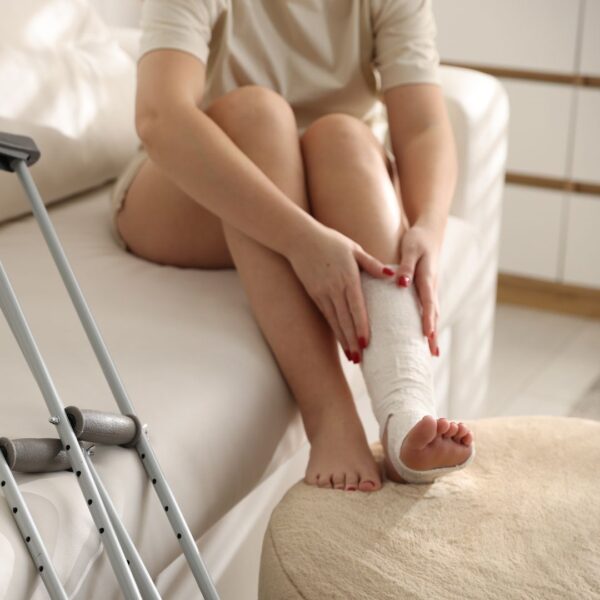
Increasing the strength and quality of your bones reduces your risk of a fracture. However, bone density isn’t the cause of most fractures– falls are. That makes fall prevention essential for protecting your bones and safeguarding your future.
Falls are common among older adults. Fortunately, there are many strategies you can employ to reduce your risk of a fall, and thereby your risk of fracture.
In this article, we review studies on the efficacy of environmental modifications designed to prevent falls, and you’ll learn practical changes you can make at home to protect your bones.
Falls In Older Adults
According to a study published in the Indian Journal of Orthopaedics, an estimated one-third of older adults experience one or more falls each year, while 10% experience multiple falls annually. The incidence rate can reach 50% among octogenarians and nonagenarians.1
These falls often cause physical injury, including fractures, and recurrent falls may result in a form of psychological trauma termed “post-fall syndrome”. Sadly, falls are responsible for significant morbidity and mortality in older adults.1
The study authors found that 30% to 50% of the documented falls resulted in minor injuries. One percent of falls in older adults result in hip fractures, which significantly increase the risk of health complications and mortality. Around 20% of falls cause serious injuries such as a fracture or a head injury.1
In the United States, 800,000 people are hospitalized each year for fall-related injuries, and 300,000 are treated for hip fractures.1
Falls are not inevitable, and researchers have identified factors that increase the risk of falling. The review study found that people rarely have only a single risk factor that leads to falls. The researchers divided these risk factors into three categories.
- Extrinsic factors — hazards in your physical environment
- Intrinsic factors — including age-related decline in function, disorders, and adverse drug effects
- Situational factors — hazards caused by an activity or behavior, for example, rushing to get to the bathroom
Synopsis
One-third of older adults experience a fall each year, with ten percent falling multiple times. These falls often result in minor or major injuries, including fractures, which can sometimes lead to other health conditions or death. Researchers divide risk factors for falls into three categories: extrinsic, intrinsic, and situational factors.
Stronger Bones. Without Drugs. Guaranteed.

The natural and evidence-based program that helps reverse osteoporosis and osteopenia in 12, 6, even 3 months… guaranteed.

The Efficacy Of Home Hazard Modification
A 2023 review of ten studies published in the journal PeerJ assessed the effect of home modifications on fall prevention among older adults. Across the 960 participants included in those studies, home hazard modifications were associated with a 7% reduction in falls.2
The researchers concluded that this benefit requires thorough, well-designed home modification interventions tailored to the individual and supported by adequate follow-up. The study concluded that combining education, home assessments and improvements, appropriate technology, and expert support offers the greatest promise for preventing falls.2
This highlights the importance of implementing changes throughout your home, not just in a single room or area. The changes should be specific to the environment and its use, and regular reassessment is needed to prevent a space from becoming dangerous again.
These changes address extrinsic risk factors, but the researchers note that the most effective intervention will also employ changes to behavior (situational factors) and careful consideration of intrinsic factors as well.3
A major intrinsic risk factor is poor leg strength. Fortunately, this is a factor that you can change through exercise focused on building lower-body strength. A systematic review published in the journal Public Health found that physical exercises are effective in improving balance, lower extremity strength, mobility, and reducing falls and fall-related injuries.4
The studies they reviewed used a wide variety of exercise programs, and ranged from using specialized gym equipment to body-weight exercises that required no equipment at all.4
The takeaway of the study is that exercise programs that increase lower-body strength and balance effectively prevent falls– and the specific type of program matters less than choosing one you can consistently maintain. If you stay consistent, you’ll see results!
Synopsis
Making changes to your living space can reduce your risk of falls by as much as 7%, according to a review of 10 studies that included nearly 1000 participants. The changes must be thorough, focused on the goal, tailored to your space and how you use it, and ideally, they should include the support of a health expert. Exercise programs to increase lower-body strength and balance can reduce the risk of falls and fall-related injuries.
Changes To Make At Home
Reducing extrinsic risk factors and modifying your home to minimize f situational risk factors can prevent falls, as the studies above demonstrate. Consider these suggestions for making your home more fall-resistant.
Home Interior Modifications
- Ensure every set of stairs has handrails on both sides, and make sure the rails are secure. Hold them anytime you traverse the stairs, even when carrying items.
- Good lighting helps prevent falls. This is especially true for stairs. Install light switches at the top and bottom of stairs and at each end of long halls. Motion-activated lights are another great way to make sure you’re never moving around in the dark.
- Keep walking paths clear and tidy. Don’t leave items on the floor or the stairs.
- Ensure that carpets and rugs are firmly secured. Purchase and apply no-slip strips on tile and wooden floors to prevent slips.
- Do not use throw rugs or small area rugs. If you have them, give them away!
- Allow freshly washed or otherwise set floors to dry completely before walking.
- Mount grab bars near toilets and both inside and outside showers and tubs.
- Place nonskid mats or strips on any surface that may get wet.
- At night, leave on your bathroom light, or use a light that automatically turns on in the dark.
- In your bedroom, have night lights and light switches near your bed.
- Keep a flashlight by your bedside in case of a power outage.
- Keep a landline or a charged phone near your bed.
- In the kitchen, smart storage is essential. Don’t store items you use regularly in hard-to-reach places.
- Clean up spills immediately.
- Electrical cords should only run along walls– never let them cross a walking path.
- Remove all furniture from walking paths — especially low furniture like coffee tables or ottomans.
- Make sure that chairs and sofas are easy to get into and out of. If they aren’t, replace them!
- Store frequently used items at waist level or somewhere easy to reach.
- Never stand on a chair or a table to reach something high up. Use a special tool for grabbing items out of reach, or ask for help. If you use a step stool, it must have a handrail on top, and you should always have a helper. Don’t use step stools alone.
- Pets can be trip hazards — always make sure you know where they are before you start moving around.
- Keep a list of emergency numbers in large print near your landline phones and save these numbers to your “favorites” list on your cell phone.
- Emergency communication is essential. You can install an in-home emergency response system to make it easier to get help in the event of a fall or other emergency using a button. Your cell phone can also serve this function, but only if you always carry it on your person.
Home Exterior Modifications
- Outside your home, make sure all steps and walkways are even and in good repair.
- On outdoor stairs, add nonslip materials.
- Clear fallen debris or other trash from lawns, decks, porches, and other areas.
- A grab bar at the front door can prevent losing your balance while unlocking the door.
- Use motion sensor lights or leave on your porch light to ensure you’re never caught in the dark.
- In the winter, monitor the weather closely, and use ice-melting products to prevent slippery ice buildup.
- Ask for help fall-proofing your home inside and out! Your doctor may be able to recommend a professional occupational therapist, physical therapist, or nurse to visit your home and advise you about changes.
A long list of modifications can feel overwhelming and may lead to inaction. Prevent overwhelm by organizing the task into small chunks. Divide these changes up into bite-sized groupings that feel manageable, and then take those chunks one by one.
You won’t be able to make every change at the same time. As you move through your list, remind yourself that every change you make increases your safety. These changes have a cumulative impact; they are not all or nothing.
Synopsis
Try implementing the changes listed above to the inside and outside of your home to reduce your risk of falls. Take changes one at a time, and remember that you don’t need to make every change all at once. Each improvement lowers your risk.
What This Means To You
Your environment plays a major role in protecting your bones. These studies show how modifications to your living space can reduce your risk of a fall, thereby helping to protect your bones.
The Osteoporosis Reversal Program uses a holistic approach to prevent fractures and improve the health of your bones. This wide-ranging approach is supported by studies like those we reviewed today, and it’s drug- and side-effect–free.
Reducing fall hazards at home is an excellent example of how lifestyle choices and behavior play an essential role in preserving your independence and protecting your health.
We also looked at a systematic review on the ability of regular exercise to reduce fall risk. The Save Institute created SaveTrainer to provide targeted exercise programs you can do at home to build bone mass, build muscle strength, and prevent falls. SaveTrainer includes programs designed to help you improve your balance and build leg strength. Best of all, SaveTrainer is available on demand, so you can exercise whenever and wherever you want.
Don’t delay; start taking preventative measures to reduce your risk of falls today.
Stronger Bones. Without Drugs. Guaranteed.
The natural and evidence-based program that helps reverse osteoporosis and osteopenia in 12, 6, even 3 months… guaranteed.

References
1 https://pmc.ncbi.nlm.nih.gov/articles/PMC7093636/
2 https://peerj.com/articles/15699/
3 https://www.sciencedirect.com/science/article/pii/S0197457223002045
4 https://www.frontiersin.org/journals/public-health/articles/10.3389/fpubh.2023.1209319/full






I stopped taking my true osteo 2 months ago. Now i fell and btoke my sholder
Is it too late to go bacck to the true osteo?
Great article, certainly worth getting started.
So glad you find this article helpful, Bob!
Great reminders in this article!
I recently switched to barefoot shoes. I’m amazed!!!! I walk 5 miles daily with no foot, knee or back pain. My balance is great.
They’re an absolute game changer.
That’s great, Christine! Keep your good habits!
Christine, you don’t mention your age. Could you clarify? I tried some barefoot shoes, but didn’t think they would enhance my safety. I’d like your specific observations. Thanks in advance.
Sherry
I’m 67.
Sorry…I didn’t elaborate.
The toe box is wide so your toes are able to spread. You’re also using your entire foot when walking.
I noticed I’m getting more of a calf and thigh workout.
I am so thankful for all the good advice. Knowledgeable staff at my healthfood store recommended taking minerals like calcium and magnesium at bedtime for best results. They do their work while you sleep.
You’re very welcome, Cheryl! Magnesium in the evening can be especially helpful because it supports relaxation and sleep.
One advice I give is NEVER hurry unless a life is at risk. I heard numerous falls or mishaps due to hurrying. I have myself experienced it a few times. A friend aged over 70 got a bad fall hurrying out of the shower to answer the phone…
That’s such an important point, Luc! Thank you for sharing it. Rushing is a common trigger for falls, so taking an extra moment to move safely can make all the difference. Your example is a powerful reminder for all of us!