


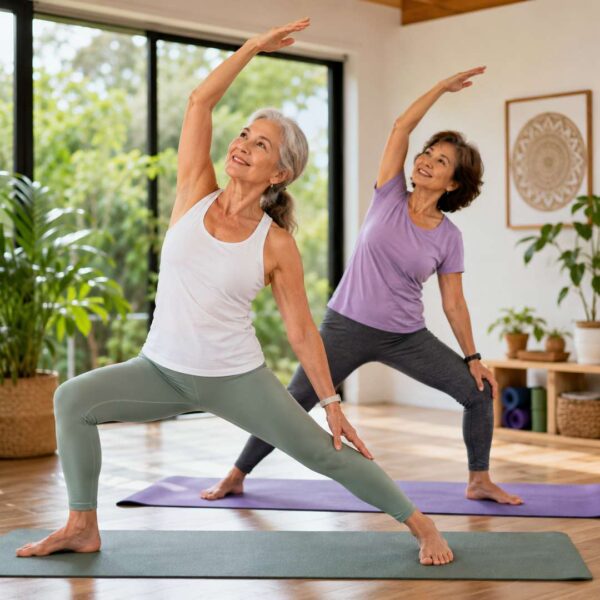
A 2025 study has found that women over 63 with greater muscle strength have a lower risk of mortality. This finding shows the power of muscle-building exercise to maintain your health and extend your life.
It is no coincidence that muscle strength correlates with bone health. A growing body of evidence links sarcopenia– the condition of low muscle strength and mass– to osteoporosis.
In this article, we’ll analyze the study linking strength to lifespan in older women, and you’ll learn about the simple actions you can take to improve your mobility, confidence, independence, and quality of life as you age.
A few moments of extra activity each day can have a profound impact on the rest of your life.
Muscle Strength In Women Over 60
A 2025 prospective cohort study published in the journal JAMA Network Open followed 5,472 women aged 63 to 99 from a baseline assessment between March 2012 and April 2014 through February 2023. The women completed physical performance testing and wore an accelerometer for seven days to measure their physical activity levels.
The physical assessment included a grip strength test and five timed unassisted sit-to-stand chair rises.
Researchers compared the participants’ assessment data with their mortality outcomes over the course of the study. They found that for every 15.4-pound increase in grip strength, participants showed, on average, a 12% lower mortality rate. Participants’ speed in the sit-to-stand test also correlated with mortality risk. When participants were grouped by speed, each six-second difference in completion time correlated with a 4% lower mortality rate.1
Higher muscle strength was associated with significantly lower all-cause mortality, even after the researchers controlled for other risk factors, including participants’ aerobic activity levels. This finding suggests that while aerobic activity is associated with mortality risk, muscle strength provides additional benefits that are independent of aerobic activity’s benefits.1
Synopsis
A study that followed nearly 5,500 women found that grip strength and sit-to-stand speed were correlated with mortality risk, even when accounting for other risk factors. Both measurements assess muscle strength, suggesting that greater muscle strength independently reduces the risk of mortality.
Ready to Put This Into Action?
Reading about bone health is a great first step, but building stronger bones requires the right type of exercise.
SaveTrainer gives you safe, expert-led workouts designed specifically for osteoporosis and osteopenia, so you can improve strength, balance, and confidence while following a structured plan.

Muscle Builds Bone
Muscles and bones work together. Stronger muscles stimulate bone remodeling, improve balance and posture, reduce falls, and help preserve independence.
The role muscles play in bone remodeling depends on mechanosensory bone cells called osteocytes. When you do weight-bearing exercise, these cells sense the force that skeletal muscle applies to bone, and they send signals to stimulate the creation of new bone tissue.2
Stronger muscles can apply greater force, which stimulates more bone formation. Greater muscle strength also improves balance and posture, both of which help prevent falls and fractures. Preventing injury preserves your ability to stay active, allowing you to keep growing stronger.
Even modest, consistent strength-building exercises, such as chair rises, resistance bands, stair climbing, or carrying groceries, can provide major benefits, even for people who don’t meet traditional exercise guidelines.
You can apply this knowledge by taking advantage of opportunities to add more physical effort to your day. Over the course of your week, see how often you can do these everyday strength-building behaviors:
- Carry your grocery bags instead of using a rolling cart.
- Whenever you stand up from a chair, repeat that motion five times to build your sit-to-stand strength.
- Take the stairs. If it’s just one flight, climb them up, back down, then up again.
- When you’re making dinner, do a few strength-building t lifts with your heaviest ingredient.
- Pick a threshold in your home– every time you cross it, do five reps of a body weight exercise of your choice– a lunge, a squat, a wall push-up, etc.
These small additions to your day will only take a few minutes, but their impact can be enormous.
Synopsis
Stronger muscles stimulate bone remodeling, improve balance and posture, reduce falls, and help preserve independence. Everyday behaviors can be muscle-building exercises. Try taking the actions listed above to increase your strength.
The Science Of The Muscle-Bone Connection
Our understanding of the connections between muscle and bone has been expanded and deepened by recent studies.3 We now understand that sarcopenia, the condition of reduced muscle strength and mass, is strongly associated with osteoporosis. Sarcopenia leads to bone loss, osteoporosis, and an increased risk of fracture.
Studies have also revealed that muscle and bone participate in a complex chemical “crosstalk”.3
Muscles behave like endocrine organs, releasing signaling molecules called myokines that act as chemical messengers. That means the relationship between muscle and bone goes beyond the physical cause and effect of mechanical load. Muscle cells communicate with bones through chemical signaling to modify the bone remodeling process.3
This complex relationship helps explain the close associations between muscle strength and bone health.
Synopsis
Sarcopenia — the condition of low muscle mass and strength — is closely associated with osteoporosis. Osteocytes are mechanosensory cells that sense the mechanical load muscles place on bone and respond by stimulating bone formation. Muscles also communicate with bones by releasing hormones as chemical messengers. This complex crosstalk underscores the importance of muscle strength for bone health.
What This Means To You
For older women, muscle strength predicts lifespan. Building stronger muscles supports better physical function, improved health, stronger bones, and a longer, more independent life.
Exercise is an absolute necessity, especially resistance exercise that builds muscle. But you don’t need a fancy gym membership or a lifetime of experience to do highly effective exercise.
The Save Institute’s online video workout platform SaveTrainer makes a regular at-home exercise routine easy and sustainable. Our expert trainers will guide you through every step with workouts tailored to your ability level and crafted to maximize bone and muscle strength.
Add one extra moment of physical activity to your day-to-day. Then add another tomorrow. Soon, you’ll have transformed your habits and put yourself on a path to a long and independent future.
Don’t Just Read About Bone-Building Exercise… Start Doing It.
Follow safe, guided workouts designed specifically for osteoporosis and osteopenia. Build strength, improve balance, and move with confidence using expert-led workout plans you can do from home.

References
1 https://jamanetwork.com/journals/jamanetworkopen/fullarticle/2845052
2 https://www.annualreviews.org/doi/full/10.1146/annurev-physiol-021119-034332
3 https://www.mdpi.com/2227-9059/5/4/62





Thank you ,Ita.
You’re very welcome, Ita!
Thank you Vivian!
You’re very welcome, Sharon!
Several years ago, I was diagnosed with osteoporosis in my left arm (I’m right hand dominant). I was told to take Fosamax. I refused opting to exercise and eat prunes daily based on a Penn State study regarding prunes and bone density. Also started to use my left arm to carry shopping bags. Two years later, the bone density in my left arm was diagnosed as osteopenia. I’m sure it has improved further but when I go for a dexa scan, they no longer scan my left arm. Residence training using bands plus eating a good diet improves your bone health and mental health.
Thank you for sharing your experience! Your story is a wonderful example of how exercise, healthy dietary choices, and simple daily habits can support bone health. It’s also encouraging that your bone density improved from osteoporosis to osteopenia. And you’re absolutely right: strength training benefits not only bone health, but mental well-being too. Keep up with your good habits!