


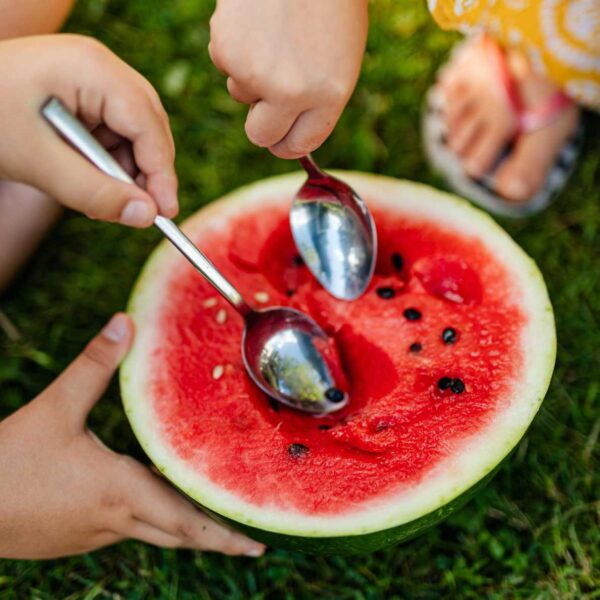
Summer is fruit season, and few fruits are as closely associated with this time of year than watermelon. This refreshing, hydrating, alkalizing fruit has a fascinating history and a surprisingly long list of bone health benefits.
In this article, you’ll learn all about this iconic fruit, how it helps you maintain strong bones, and a variety of ways to incorporate it into your summer meals.
The Mysterious Origins Of Watermelon
The origin of the watermelon was a hotly debated question for hundreds of years, with scholars speculating that the fruit might have first been cultivated in Southern Europe, the Middle East, South Africa, or even Central Asia.
The earliest archeological evidence pointed toward Northeast Africa, with seeds and leaves found preserved in tombs and archeological sites in Egypt and Sudan dating back thousands of years. Two Ancient Egyptian illustrations appear to depict watermelons, the older of which is in the tomb of Chnumhotep near Saqqara and dates to 4360 to 4350 BP.
While these illustrations proved that this fruit was already being eaten and likely cultivated by ancient Egyptian farmers, it didn’t settle the question of origin.
Genomic analysis provided the key to solving the puzzle. A study published in 2021 provides compelling genetic evidence that the progenitor of the watermelon is an unassuming wild fruit that still grows in the Kordofan region of Sudan. The researchers postulate that the Kordofan melon, which has white, non-bitter flesh, was cultivated into the watermelon we know today.1 From there, it spread across the world.
Written evidence suggests that watermelon made its way to India by the 9th century and China by the 10th. The fruit is illustrated in Medieval European manuscripts starting in the 13th century.
Watermelon traveled to the New World in the 1600s. Already familiar to many enslaved Africans and European colonists, it was quickly adopted by Native Americans, who were cultivating the fruit by the mid-17th century.
In the 1850s, famous British explorer David Livingstone mistakenly assumed he had discovered the origin of the watermelon in the Kalahari Desert of Southwestern Africa. He observed many acres of melons growing wild and learned from locals that the fruit was more than a delicious treat– it was an essential resource for surviving in the desert.
During long dry spells, the melons acted as natural reservoirs of fresh water. Smaller melons could act as natural canteens, making a supply of life-giving water portable across distances.
Eat Your Way to Stronger Bones
Enjoy 200+ delicious, bone-strengthening recipes designed to naturally support bone health—without spending hours in the kitchen. Bone Appétit makes eating for stronger bones simple, satisfying, and stress-free.

This health benefit of watermelons– hydration— persists today, even where clean drinking water is readily available. For the ancient Sudanese farmers who first began cultivating Kordofan melons into what we would recognize today as a watermelon, this foundational health benefit was likely a prized feature.
You might not think of watermelon as a particularly nutritious food, but just as it did thousands of years ago, a juicy slice provides benefits that extend well beyond satisfying your sweet tooth — including benefits for your bones.
Synopsis
The origin of watermelon was a hotly debated question for hundreds of years, but genomic processing has traced its roots to a Sudanese melon that still grows wild. In desert regions, watermelons have long been prized as repositories of drinking water. Hydration remains one of this fruit’s many health benefits.
Bone Health Benefits Of Watermelon
Watermelon doesn’t directly provide the key building blocks for new bone mass the way some foods do. Instead, it contains nutrients and phytochemicals that support several biological processes involved in healthy bone remodeling.
Even if watermelon only provided one or two beneficial compounds, it would still be a worthwhile addition to a bone-healthy diet. But this juicy fruit offers much more than that.
Reduces oxidative stress
Watermelon contains two powerful antioxidants, lycopene and Vitamin C, that studies have shown help reduce inflammation and oxidative damage. Lycopene is a natural pigment belonging to the carotenoid family. Together, these compounds help protect cells from oxidative stress, including the cells responsible for healthy bone remodeling.2
Lowers chronic inflammation
Watermelon also contains the carotenoid beta-cryptoxanthin, which may help protect joints from inflammation.3 Some studies have found that this pigment helps prevent osteoporosis by stimulating bone formation.4
Promotes muscle growth
Watermelon provides L-citrulline, an amino acid that has been found to promote muscle protein synthesis. This may help explain why studies have linked watermelon consumption to lower rates of sarcopenia (the condition of low muscle mass and strength) in elderly Chinese adults.5 Muscle mass and bone growth are closely linked because muscle contraction creates the mechanical load that stimulates new bone growth.
Is nutrient dense
A 2022 study associated watermelon intake with increased nutrient intake and higher quality diets in adults and children. The study observed higher levels of fiber, magnesium, potassium, vitamin C, vitamin A, lycopene, and other carotenoids in participants with higher watermelon intake.6
Promotes collagen synthesis
The Vitamin C in watermelon supports collagen synthesis.7 This is great for keeping your skin youthful, and it’s also essential for healthy bone composition. Without enough collagen, bones become brittle, increasing the risk of fracture.
Improves hydration
Adequate hydration is essential for bone health and overall wellness. Watermelon is about 92% water while remaining rich in beneficial nutrients and providing only 80 calories per two-cup serving. Watermelon is a great way to boost your water intake.
Supports exercise
The citrulline in watermelon supports muscle recovery after exercise, helping to reduce soreness and allowing you to get more out of your bone-building workouts.8
Contributes to overall healthy aging and cardiometabolic health
A small study published in the journal Nutrients found that participants who drank watermelon juice for two weeks had improved heart rate, blood pressure, and nitric oxide production. The study concluded that L-citrulline and L-arginine helped protect vascular function when participants’ blood sugar levels were high. This protection promotes healthier aging and cardiovascular function.9
Synopsis
Watermelon contains a wide variety of vitamins and beneficial compounds that support bone health by reducing oxidative damage and g inflammation, promoting muscle growth, supporting hydration and collagen synthesis, aiding exercise recovery, and contributing to healthy aging.
Ways To Eat More Watermelon
While biting into a juicy watermelon wedge might be the most iconic way to enjoy this fruit, there are plenty of creative ways to include it in your meals. Try some of these ideas for incorporating watermelon into your bone-building diet.
- In a beverage – Toss some chunks of seedless watermelon into a blender, and you’ve instantly got the base for a variety of delicious summer beverages. Add some sparkling water for a healthy watermelon spritz, or make watermelon lemonade with freshly squeezed lemons (a great way to boost your vitamin C intake). If you thought watermelon juice was refreshing, try mixing it with cucumber juice over ice– add a splash of seltzer to make it effervescent.
- In a smoothie – Summer is fresh fruit season, which makes it prime time for fruit smoothies. Instead of using water, juice, or almond milk as your smoothie base, try adding watermelon instead. A cup or so of watermelon provides plenty of liquid while adding vitamins and beneficial plant compounds.
- On a salad – You’ve probably encountered a watermelon, mint, and feta salad before– but watermelon makes a great addition to leafy green salads as well. A burst of moisture and sweetness can make your salad a refreshing summertime hit.
- On your yogurt bowl – Try dicing watermelon into small cubes and adding it to a yogurt bowl or parfait. This makes a great breakfast or midday snack.
- Watermelon Kebabs – Put your leftover skewers to good use by cubing some watermelon and alternating with berries, other melons, slices of cucumber, or other fruits and veggies– great for summer garden parties!
- Grilled watermelon – If you’ve already got the grill fired up for a summer barbecue, try tossing slices of watermelon on the hot grill for a couple of minutes. Sprinkle it with sea salt for a surprising sweet-salty treat.
Synopsis
Try some of the suggestions above to incorporate watermelon into your summertime meals.
What This Means To You
Whether you bring home a whole melon, pick up a quarter melon, or buy it pre-cut, this refreshing fruit has plenty to offer your bone health.
Building a diet full of bone-healthy foods doesn’t need to feel like guesswork. The Save Institute created Bone Appétit to make it easy for you to turn every meal into a delicious step forward on your path to stronger bones. With recipes featuring your favorite foods (like watermelon!) in dishes, desserts, smoothies, and more– Bone Appétit has the perfect answer for every occasion.
This summer, stay cool, keep hydrated, and eat watermelon!
Delicious, Bone-Healthy Meals Made Simple
Support your bones with 200+ easy, flavorful recipes designed to naturally boost bone strength—without spending hours in the kitchen. Bone Appétit takes the guesswork out of eating for bone health, so you can enjoy every meal with confidence.

References
1 https://www.pnas.org/doi/10.1073/pnas.2101486118
2 https://pubmed.ncbi.nlm.nih.gov/33187365/
3 https://www.ncbi.nlm.nih.gov/pmc/articles/PMC7698065/
4 https://pmc.ncbi.nlm.nih.gov/articles/PMC4892306/
5 https://pmc.ncbi.nlm.nih.gov/articles/PMC12518088/
6 https://www.mdpi.com/2072-6643/14/22/4883
7 https://www.ncbi.nlm.nih.gov/pmc/articles/PMC5579659/





I like watermelon but it doesn’t have enough fiber unless you find the rare seedED one. I don’t eat it often. Also, most stores very sadly, don’t sell very many seedED organic ones (chew the seeds for extra protein and maybe some fiber)! These are both ultra important and also for grapes (chew the seeds for FREE grape seed extract)
Yum! More reasons now for me to eat this delicios fruit! Thanks!
Enjoy! And you’re welcome 😀
Good to know! I love watermelon. Thank you Vivian!
You’re very welcome, Kathy!
Though I love it, it’s too high in carbs for my 20-carb day, But I also love watermelon seed butter, which is great on flax crackers, only flax seeds.
Thanks for sharing! Watermelon seed butter is a creative alternative, and it can be a great way to enjoy some valuable nutrients while keeping your carb intake low. They contain magnesium, zinc, iron, and copper. It’s all about finding options that fit your personal goals while still supporting your bone health and overall health.