


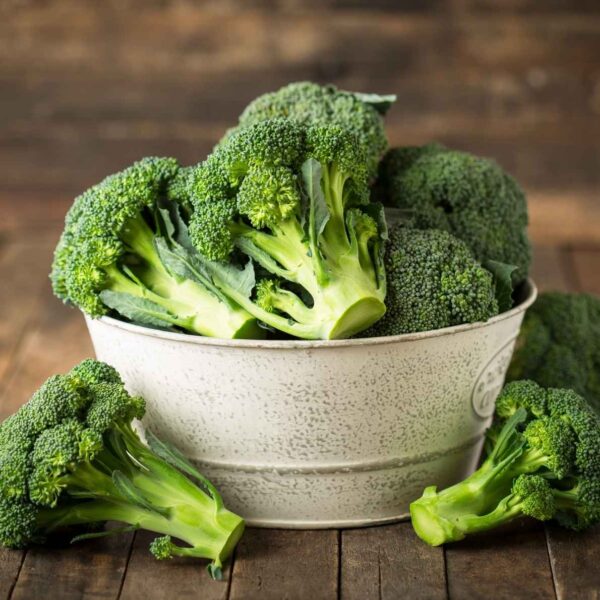
Broccoli is a powerhouse alkalizing vegetable with a wide variety of benefits for your health and your bones. For generations, parents have told their kids, “You have to eat your broccoli” as a shorthand for doing what’s good for your health, even if you don’t love it– but there’s no reason not to love broccoli!
We’ll prove it in this article, with a wealth of scientific evidence supporting broccoli’s health benefits, along with two recipes sure to make this vegetable your new favorite.
All About Broccoli
Broccoli is a cruciferous green vegetable that resembles a tiny tree, with a thick edible stalk as the trunk and dense clusters of green flower buds (florets) forming the canopy of the “tree.” It’s closely related to other cruciferous vegetables such as Brussels sprouts, kale, and cauliflower.
Broccoli was first cultivated in the Mediterranean region during the sixth century BCE. The plant was refined by farmers across present-day Italy for hundreds of years, then it spread to northern Europe by the 18th century and North America in the 19th century, thanks to Italian immigrants.
Broccoli is a rich source of several important nutrients, including fiber, vitamins A, C, and K, calcium, potassium, iron, and several antioxidant compounds, such as sulforaphane. These compounds have significant health benefits, including potent antioxidant, anti-inflammatory, and anticancer effects.1
Synopsis
Broccoli is a cruciferous green vegetable closely related to Brussels sprouts, kale, and cauliflower first cultivated in ancient Italy. Broccoli is a rich source of important nutrients and compounds that confer potent antioxidant, anti-inflammatory, and anticancer benefits.
Broccoli And Your Bones
Broccoli contains numerous compounds that benefit your bones, either directly or indirectly, and it is listed in the Osteoporosis Reversal Program as a Foundation Food.
Broccoli’s Vitamin K content helps improve bone quality and reduce fracture risk. A 2020 study published in Bone Reports conducted a four-week randomized controlled trial in middle aged and older adults and found that participants who increased their intake of vitamin K-rich green leafy vegetables by two to three servings per day increased osteocalcin uptake into the bone matrix. Broccoli is an excellent source of Vitamin K, and this finding directly links it to bone formation.2
Another study found that co-supplementation with Vitamin K and calcium was associated with a higher lumbar spine bone mineral density.3 Broccoli is an excellent source of both nutrients.
Eat Your Way to Stronger Bones
Enjoy 200+ delicious, bone-strengthening recipes designed to naturally support bone health—without spending hours in the kitchen. Bone Appétit makes eating for stronger bones simple, satisfying, and stress-free.

Broccoli also provides sulforaphane, a naturally occurring organosulfur compound that stimulates osteoblast bone formation and diminishes osteoclast bone resorption. This effect occurs through an epigenetic pathway, meaning sulforaphane activates gene expression that favors bone formation. 4
The antioxidant compounds in broccoli protect your body from oxidative damage, including the cells that carry out the bone remodeling process. Sulforaphane is one of broccoli’s most potent antioxidants, and these effects complement its epigenetic bone-building properties.
Additionally, broccoli contains measurable amounts of the antioxidants lutein and zeaxanthin, which reduce oxidative stress and cellular damage in your eyes.5 Good vision is critical for avoiding trips and falls, which can lead to fractures. Maintaining your vision is also important for keeping up with your bone-building behaviors, like regular exercise.
Several of broccoli’s bioactive compounds have been shown to reduce inflammation. Researchers have suggested that multiple compounds work synergistically to create the effect, although some individual compounds also have anti-inflammatory abilities. One flavonoid found in broccoli, kaempferol, has demonstrated strong anti-inflammatory effects in both animal and laboratory studies.6 Inflammation impedes bone remodeling, threatening bone mass, so broccoli’s anti-inflammatory effect also protects bone.
Synopsis
Broccoli offers many bone-health benefits, both directly and indirectly. Vitamin K, calcium, and sulforaphane encourage bone formation, while antioxidants and anti-inflammatory compounds protect bone and the bone remodeling process.
Additional Health Benefits Of Broccoli
Studies have found that broccoli may help reduce the risk of certain types of cancer including breast, prostate, stomach, colorectal, renal, and bladder cancer.7,8,9,10,11,12
Eating broccoli may improve blood sugar regulation in people with diabetes. One human study showed significantly decreased insulin resistance in people with type 2 diabetes who consumed broccoli sprouts daily for one month.13
Blood sugar regulation is also important for bone health because spikes in blood sugar can impair bone remodeling, and type 2 diabetes is associated with bone loss and osteoporosis.
Broccoli is a great source of fiber, which supports heart and digestive health by helping prevent constipation and promoting nutrient absorption.
Studies have found that broccoli can help preserve cognitive function. In a study of 960 older adults, consuming one daily serving of dark green vegetables, such as broccoli, was associated with slower age-related cognitive decline.14 A review of studies found that kaempferol may be the source of that benefit, as it protects the brain against neurodegenerative disease.15
Broccoli’s Vitamin C content supports immune function, keeping you healthy and active. Vitamin C is also essential for collagen production, a major structural component of bone.
Synopsis
Broccoli has been found to reduce the risk of certain types of cancer, improve blood sugar regulation in people with diabetes, improve digestion, reduce age-related cognitive decline, and support immune function.
How To Enjoy Eating Your Broccoli
If you’ve only ever eaten broccoli that was boiled into an unappetizing pile of mushy green fibers, then it’s time to reevaluate the culinary potential of this vegetable. Broccoli is incredibly flavorful and versatile.
Raw, it makes an excellent and crunchy addition to salads or as a standalone snack dipped in hummus. It can also be prepared in countless delicious ways. Try it sautéed with a little extra-virgin olive oil; steamed until it turns bright green, but not so long that it loses its crunch; baked in the oven alongside chicken or another protein; or in soups and stews.
No matter how you eat it, The Save Institute recommends buying organic broccoli to reduce your intake of residual pesticides and other toxic chemicals. These two recipes feature broccoli in hearty stews, a preparation that suits this versatile vegetable especially well.
Lemon-Ginger Chicken and Broccoli Pot Stew
pH-Balanced
4 Servings
Ingredients
- 1 lb chicken breast cut into bite-sized cubes
- 1 head of broccoli, florets and stems chopped
- 1 can (15 oz) lima beans, rinsed
- 1 tbsp fresh ginger, minced
- 2 garlic cloves, minced
- 4 cups vegetable broth
- 1 tbsp olive oil
- Juice of 1 fresh lemon
Directions
- Heat olive oil in the pot over medium heat. Sauté chicken cubes for 5 minutes until browned on the outside.
- Add minced garlic and ginger. Stir for 1 minute until fragrant.
- Pour in the broth and add the rinsed beans and chopped broccoli stems. Cover and simmer on medium-low for 10 minutes or until chicken is cooked through.
- Stir in the broccoli florets. Cook uncovered for 5 minutes until tender-crisp. Remove from heat and stir in the fresh lemon juice.
Lentil Broccoli Stew
pH-Balanced
4 Servings
Ingredients
- 1 block (14 oz) extra-firm organic tofu, pressed and cubed
- 1/2 cup dry organic red lentils, rinsed
- 1 head of broccoli, florets and stems chopped
- 1 small yellow onion, diced
- 3 cups vegetable broth
- 1 cup water
- 1 tbsp olive oil
- 1 tsp ground cumin or turmeric
Directions
- Heat olive oil in the pot. Sauté the diced onion and tofu cubes for 5 minutes until the tofu edges start to crisp.
- Stir in the cumin or turmeric and let the spices toast for 30 seconds.
- Add the red lentils, vegetable broth, water, and broccoli stems. Bring to a boil, then reduce heat to low, cover, and simmer for 15 to 20 minutes (or more, if necessary), until lentils are soft.
- Add the broccoli florets to the top of the stew. Cover and simmer for at least 5 more minutes until the lentils are soft and the broccoli is fully cooked.
What This Means To You
Don’t pass the broccoli by on your next trip to the grocery store. Try one of these delicious recipes featuring this bone-building vegetable.
For more recipes featuring alkalizing, bone-building foods, check out Bone Appétit. Bone Appétit is the Save Institute’s cookbook and meal planner taking the guesswork out of preparing delicious bone-healthy meals. When you choose a recipe from Bone Appetit, you know it will be delicious, nutritious, bone-healthy, and easy to make.
Eating a wide variety of bone-healthy foods is essential for maintaining physical function and preventing fractures. Keep expanding your palate and your pantry with bone-building foods.
Delicious, Bone-Healthy Meals Made Simple
Support your bones with 200+ easy, flavorful recipes designed to naturally boost bone strength—without spending hours in the kitchen. Bone Appétit takes the guesswork out of eating for bone health, so you can enjoy every meal with confidence.

References
1 https://pmc.ncbi.nlm.nih.gov/articles/PMC10376324/
2 https://pubmed.ncbi.nlm.nih.gov/32455149/
3 https://examine.com/research-feed/study/9oPpkd/
4 https://www.jbc.org/content/early/2016/01/12/jbc.M115.678235
5 https://www.mdpi.com/2076-3921/9/11/1046
6 https://pubmed.ncbi.nlm.nih.gov/39754793/
7 https://pubmed.ncbi.nlm.nih.gov/22877795/
8 https://pubmed.ncbi.nlm.nih.gov/22121852/
9 https://pmc.ncbi.nlm.nih.gov/articles/PMC7657120/
10 https://pmc.ncbi.nlm.nih.gov/articles/PMC3603442/
11 https://pubmed.ncbi.nlm.nih.gov/23859034/
12 https://pubmed.ncbi.nlm.nih.gov/22391648/
13 https://pubmed.ncbi.nlm.nih.gov/22537070/
14 https://pmc.ncbi.nlm.nih.gov/articles/PMC5772164/
15 https://www.sciencedirect.com/science/article/pii/S0753332223010065






Broccoli is one of my favourite vegetables so thanks Vivian for the recipes.
Great info. Thanks!
My pleasure, Kathy!
Thank you Vivian! I like brocoli but don’t use it in recipes. These sound really delicious and I will definitely try them.
That’s great, Linda! And you’re very welcome!
Couldn’t you use cauliflower instead? Like the organic, frozen cauliflower rice that Trader Joes carries?
Cauliflower is also a wonderful Foundation Food and another member of the cruciferous vegetable family, so it’s a great choice for a bone-healthy diet. While broccoli has a bit more vitamin K, vitamin C, and sulforaphane, cauliflower provides many of the same bone-supporting nutrients and beneficial plant compounds.
Frozen organic cauliflower rice from Trader Joe’s is a convenient option, too. 😊
We also have an article all about cauliflower, including a delicious recipe: https://saveourbones.com/a-bone-healthy-bread-made-with-cauliflower/
Enjoy!