


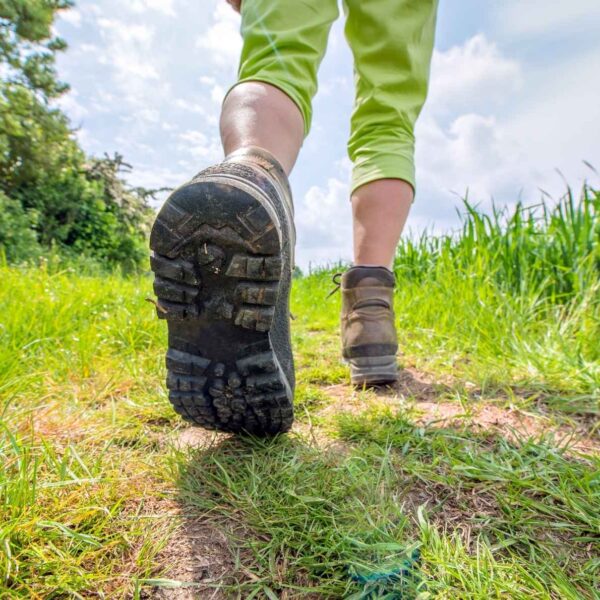
Walking is one of the most commonly recommended exercises for osteoporosis because it’s weight-bearing, accessible, and has many health benefits. However, scientific studies measuring the impact of walking on bone health have found that it’s simply not enough to counteract bone loss.
In this article, we’ll examine two of those studies and learn why walking as the only form of exercise is not enough to stimulate bone growth to strengthen bones. Then you’ll learn about the forms of exercise that have been found to more effectively increase bone mass.
Walking Is Good For Your Health, But Not Enough For Your Bones
The positive health effects of walking are well documented, and walking remains an important practice for maintaining your health and wellness. But when it comes to bone strength, studies have found that walking isn’t the most effective strategy — especially for post- and perimenopausal women and people with osteoporosis.1,2
A study published in 2005 in the Journal of Geriatric Physical Therapy conducted a meta-analysis of ten studies on the effect of walking on bone mineral density (BMD) in postmenopausal women and both men and women over the age of 50.1
Their analysis revealed that walking had a significant positive effect on lumbar spine bone mineral density, but not at the other sites they evaluated: the femur and the calcaneus, otherwise known as the heel bone.1
The researchers concluded that walking interventions alone will not limit bone loss across all skeletal sites. Therefore, they recommended that people at risk for osteoporosis include other forms of exercise in their training regimens in addition to walking.1
Another meta-analysis and systematic review published in 2013 in the journal Menopause investigated the effects of walking on the preservation of bone mineral density (BMD) in perimenopausal and postmenopausal women.2
This review found that walking had no significant effects on BMD at the lumbar spine, the radius, or for the whole body, but that in interventions lasting more than six months, participants showed significant positive effects on femoral neck bone mineral density.2
Although the studies included in these two meta-analyses reported somewhat different findings, they reached the same conclusion — walking strengthens some bones, but not all.
That makes walking a valuable part of your overall bone-building activities, but walking shouldn’t be your only bone-building exercise. The data show that a walking-only intervention simply isn’t sufficient to prevent or reverse osteoporosis.
Ready to Put This Into Action?
Reading about bone health is a great first step, but building stronger bones requires the right type of exercise.
SaveTrainer gives you safe, expert-led workouts designed specifically for osteoporosis and osteopenia, so you can improve strength, balance, and confidence while following a structured plan.

Synopsis
Studies have found that walking can improve bone mineral density at some, but not all, skeletal sites. Therefore, walking alone cannot prevent and reverse osteoporosis and should be combined with other forms of exercise.
Add Resistance Training To Your Bone-Building Exercise
In 2013, an international panel of experts convened to issue consensus exercise recommendations for individuals with osteoporosis or osteoporotic vertebral fractures.3
Their recommendations, published in the journal Osteoporosis International, are as follows:
“The panel strongly recommends a multicomponent exercise program including resistance and balance training for individuals with osteoporosis or osteoporotic vertebral fracture. The panel recommends that older adults with osteoporosis or vertebral fracture do not engage in aerobic training to the exclusion of resistance or balance training.”3
The panel doesn’t recommend forgoing aerobic exercise, such as walking — but it cautions against making aerobic exercise your only form of physical activity. They specifically name resistance and balance training as the core of an effective multi-component exercise program.
This recommendation reinforces findings from numerous studies showing that resistance training significantly improves bone strength and bone mineral density.
A 2018 study published in the Journal of Bone Mineral Research included 101 postmenopausal women with low bone mass and randomized them into either eight months of twice-weekly, 30-minute supervised high-intensity resistance interval training (HiRIT) or a home-based, low-intensity exercise program.4
The researchers measured participants’ lumbar spine and proximal femur BMD and their functional performance before and after the interventions.
They found that the HiRIT program was superior to the low-intensity exercise program for improving lumbar spine BMD, femoral neck cortical thickness, height, and all measures of functional performance. Furthermore, the researchers found the high-intensity program, performed under direct supervision, to be a safe intervention for postmenopausal women with low bone mass.4
A meta-analysis published in 2021 in the Journal of Bone Mineral Metabolism included nine randomized controlled trials with participants with osteoporosis and osteopenia. Across those studies, 259 participants were in high-load resistance training groups, and 236 participants were in control groups. The study found that high-load resistance training was effective in increasing BMD, especially of the lumbar spine.5
A study published in 2021 in the journal Physical Therapy conducted a meta-analysis of 53 studies of progressive resistance training programs for men and women aged 50 years or older with low BMD or a history of fractures.6
It concluded that people at risk of fractures should be encouraged to include progressive resistance training for its positive effects on femoral neck BMD, health-related quality of life, physical functioning, and pain. 6
Synopsis
Studies have consistently shown that resistance training is effective for increasing bone mineral density across multiple skeletal sites, including, high-load, progressive resistance training, and when appropriate, high-impact exercise.
Weight-Bearing Vs Resistance Training and How Exercise Builds Bone
The studies reviewed above make it clear that resistance training is an essential part of every Saver’s bone-building exercise routine.
The fact that walking alone isn’t enough may come as a surprise to some people, given how much attention the benefits of walking have received. But walking places a different type and magnitude of mechanical stress on bone than resistance training — and that difference explains why walking isn’t enough.
Bone formation is stimulated by the mechanical load that exercise places on bone. Mechanosensitive bone cells respond to the physical stress of mechanical load by triggering bone formation processes. This cause-and-effect is described by Wolff’s Law, which states that bones adapt to use by growing stronger.
In addition to its broader health benefits, walking provides weight-bearing exercise that stimulates some bone formation, consistent with Wolff’s Law. Weight-bearing exercise is physical activity that requires your body to bear its own weight under the force of gravity.
Propelling your body forward step after step requires your muscles to place stress on your bones, and your body remains upright — in opposition to the downward force of gravity. These forces are responsible for the moderate positive effect on bone mineral density that studies have linked to walking.
However, as we saw, studies have also confirmed the limitations of walking for bone formation. Resistance training has proved more effective at building bone.
Resistance training differs from weight-bearing exercise. Resistance training increases the amount of force your muscles exert on your bones beyond what is required to resist gravity or move your body through space under its own weight. Resistance training usually employs tools to help accomplish this task: resistance bands, dumbbells, weight machines, etc. Body-weight exercises can also be performed in ways that provide progressive resistance and stimulate bone growth.
The tools and strategies deployed by resistance training increase the resistance your muscles must overcome to contract. This increased resistance translates to greater force applied to your bones. In keeping with Wolff’s Law — that bone adapts to use — greater mechanical loading generally stimulates a stronger bone-building response.
Walking plays an important role to play in your bone health and overall wellness. It’s an excellent part of an active, bone-healthy lifestyle, improving cardiovascular fitness, mobility, and balance.
The best approach is to continue walking while also incorporating resistance training into your exercise program for optimal bone health.
Synopsis
Wolff’s Law states that bone adapts to mechanical loading by becoming stronger in response to the forces muscles place on it. Weight-bearing exercise does not apply as much force to your bones as resistance training, and therefore does not stimulate as much bone growth. Resistance training should be incorporated alongside walking to optimize overall health and bone strength.
What This Means To You
Walking is one of the simplest and most enjoyable ways to stay active, and I hope you’ll continue to make it part of your day.
But as the studies we’ve examined today show, your bones need more than walking alone. They respond best when you give them a variety of challenges — including resistance and balance exercises that place greater, targeted loads on the skeleton.
And that doesn’t mean you suddenly have to become a weightlifter or spend an hour at the gym.
In fact, one of the biggest obstacles I hear from Savers isn’t a lack of motivation. It’s simply not knowing what to do next.
Which exercises are appropriate for you? How long should you exercise? What should you combine with your walks? And how do you progress without doing too much, too soon?
That’s exactly why we created SaveTrainer.
It gives you bone-healthy workouts you can follow at home, along with a personalized plan based on a simple 10-minute physical assessment. It takes into account your goals, experience level, and needs. So instead of having to piece together an exercise routine on your own, you can simply follow along the plan built just for you.
And your walking doesn’t have to disappear from the picture.
For example, inside SaveTrainer you’ll find Let’s Take A Walk, a 15-minute Beginner/Intermediate workout, and Walk It Out, a gentle 7-minute Beginner workout. They’re an easy way to get moving on days when you want something short and approachable.
Then, on other days, SaveTrainer can help you incorporate the resistance, balance, strength, and other bone-building exercises that walking alone can’t provide.
That combination is what matters.
You don’t need to exercise perfectly. You need a routine that gives your bones the right stimulus — and that you can realistically keep doing.
So if you’ve ever wondered whether SaveTrainer might make that easier, I invite you to take a look.
You may find that having the workouts, guidance, and next steps already laid out for you makes building stronger bones feel much simpler than you expected.
Don’t Just Read About Bone-Building Exercise… Start Doing It.
Follow safe, guided workouts designed specifically for osteoporosis and osteopenia. Build strength, improve balance, and move with confidence using expert-led workout plans you can do from home.

References
1 https://pubmed.ncbi.nlm.nih.gov/16386172/
2 https://pubmed.ncbi.nlm.nih.gov/24149921/
3 https://pubmed.ncbi.nlm.nih.gov/24281053/
4 https://pubmed.ncbi.nlm.nih.gov/28975661/





Thank you , Ita .
You’re very welcome, Ita!
Thank you Vivian! Fortunately since I retired I have time to walk and exercise almost every day. I notice a difference and I’m also following your program.
You’re welcome, Claire! Keep up with your good habits!
How envious are half the population who cannot access your wonderful videos etc online.
Surely save our bones are financially able by now to provide videos and books which people could purchase?
Kind regards
Jane
Hi Jane,
Thank you for your kind words and for bringing this up. Our programs and exercise videos are available for purchase, but they are provided in digital format rather than as printed books or DVDs. We understand that this can make them difficult to access for people who don’t use the Internet, and we appreciate your feedback and suggestion.
In good health,
Vivian