


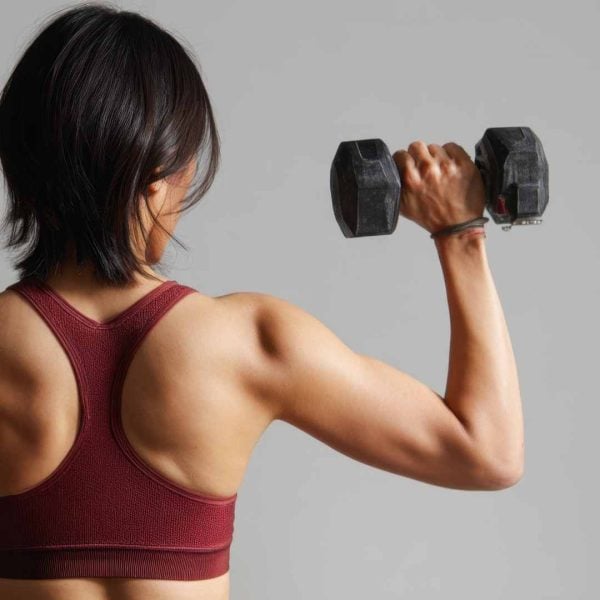
If two groups of people in their 70s, one a group of master athletes and the other a group of adults who never consistently exercised, completed the same resistance routine, which group would have the greater capacity to build new muscle?
A team of researchers in England thought the answer was obvious: the master athletes would be better equipped to build new muscle– but they were wrong.
We’ll examine the study and what it shows: you can start building muscle at any age, whether you’re a lifelong athlete or brand new to working out. We’ll also cover why this is great news for Savers and how to apply these findings to build stronger, healthier bones.
An Incorrect Hypothesis Leads To A Brilliant Discovery
According to a study published in the journal Frontiers, first-time exercisers have the same capacity tor build muscle as long-time athletes.
Researchers enrolled 15 older men to determine whether lifelong athletes have a greater ability to build muscle than people who haven’t exercised regularly. The first group, termed “master athletes,” was composed of lifelong exercisers who still competed at a high level in their sport of choice. The other group consisted of generally healthy, age-matched men who had never engaged in structured exercise training beyond recreational activities.1
Researchers administered an isotope tracer to each participant to track how muscle proteins developed. Each man then completed a resistance-training session routine using free weights or exercise machines.
Muscle biopsies were taken 48 hours before and after each session to examine how each participant’s muscle proteins responded to exercise.
They found that despite the master athletes’ long-term endurance training, their myofibrillar protein remodeling in response to resistance exercise was similar to that of the untrained group.1
The non-athletes built muscle just as effectively as the lifelong athletes.
Synopsis
Ready to Put This Into Action?
Reading about bone health is a great first step, but building stronger bones requires the right type of exercise.
SaveTrainer gives you safe, expert-led workouts designed specifically for osteoporosis and osteopenia, so you can improve strength, balance, and confidence while following a structured plan.
Researchers compared how lifelong master athletes and age-matched untrained men responded to resistance exercise: lifelong master athletes and men who never participated in structured exercise training. Remarkably, both groups showed the same capacity to build new muscle, proving that past exercise habits don’t determine muscle-building potential.
It’s Not Too Late To Start Building Muscle, And Why You Should
This finding even surprised the scientists who conducted the study.
You might be holding on to misconceptions about your muscle-building potential, similar to the researchers’ initial assumptions. We now have evidence that even if you’ve never exercised regularly, you’re not at a disadvantage in building new muscle.
This matters for Savers because building muscle mass helps build bone. According to Wolff’s Law, bone adapts to the forces placed upon it. Muscles apply those forces so low muscle mass reduces the stimulus for new bone formation.
Muscle loss and bone loss go hand in hand. There’s even a name for their overlap: osteosarcopenia– the intersection of sarcopenia and osteoporosis.
Now that you know, take action and put this finding to good use. Whether you’ve been active your whole life or mostly inactive, your body is ready to adapt to resistance training by building new muscle. Take advantage of this remarkable capacity.
Consider starting a resistance-training or weight-lifting program. Many workouts incorporate resistance training using free weights, machines, or body-weight movements that stimulate muscle growth.
Synopsis
Because muscle loss and bone loss are linked, building more muscle mass increases the stimulus for bone formation, which helps you to prevent or reverse osteoporosis. Take advantage of your body’s incredible ability to readily build new muscle, regardless of your level of athleticism.
What This Means To You
Focus on building muscle. Your body is ready and able to add muscle mass in response to resistance training, regardless of your previous exercise habits.
Your muscles are ready and waiting to grow– and weight-bearing exercise also stimulates new bone growth.
Finding the right workout can be a challenge, especially with specific goals in mind. That’s why the Save Institute created SaveTrainer, an online workout platform created to help you prevent and reverse osteoporosis with effective, efficient, enjoyable exercise programs.
No matter your experience or ability level, SaveTrainer offers workouts tailored just for you, across many class types. SaveTrainer offers bone strength, joint health, balance, posture, flexibility, meditation, sleep-enhancing, and yoga classes.
Take advantage of your body’s incredible abilities and use bone-safe exercise to build stronger muscles, stronger bones, and a more active future. Try SaveTrainer now →
Don’t Just Read About Bone-Building Exercise… Start Doing It.
Follow safe, guided workouts designed specifically for osteoporosis and osteopenia. Build strength, improve balance, and move with confidence using expert-led workout plans you can do from home.

References
1 https://www.frontiersin.org/journals/physiology/articles/10.3389/fphys.2019.01084/full




I’m looking forward to joining your class. You will see me. Thank upu.
It is an interesting article. I notice it was research was done on older men, not women. Men and women, as we know are anatomically different, particularly the endocrine system, therefore, the research result do not really apply to women, sadly.
Hello Vivian
I very much appreciate your emails – so informative, with much research, knowledge and wisdom.
I am a frail 81 year old woman with advanced osteoporosis. Just wondering, does your exercise program cater for the likes of me. Thank you
Good to know! My sister is in her 70’s and seems to be wasting away. Doesnt exercise, and her excuse is that at this point in her life it wouldn’t make a difference. I will show her this article and hopefully it will make her exercise and get stronger. Thank you!
My pleasure, Lenny! I hope it will help your sister!
Thanks for giving us helpful information, Vivian!
You’re very welcome, Sharon!