


A study published in March of 2026 found that a mere four minutes of daily resistance exercise significantly improved the physical function of older adults with impaired mobility.
This remarkable finding underscores the irrefutable power of exercise to improve physical function. In this article, we’ll analyze the details of the study, and you’ll learn how to apply its findings.
We’ll also connect these findings to the ability of bone-building exercise programs to improve overall well-being, physical capacity, and bone health.
Study Puts Four-Minute Workouts To The Test
The study, published in the journal PLOS One, included 97 adults aged 65 and older who reported serious difficulty walking. Sixty-eight percent of the participants were women.1
The researchers divided them into two groups: the FAST-2 intervention group, who performed a daily four-minute workout comprising four 30-second exercises, and a control group with no exercise intervention.
The FAST-2 group’s workout consisted of four exercises: push-ups, chair stands, seated rows using a resistance band, and stepping up and down on a small platform. Each lasted 30 seconds, with 30 seconds of rest between each exercise.
Not every participant had the same level of strength or physical function, so the researchers accommodated each participant with modifications. For example, someone who couldn’t complete a standard push-up might be instructed to do the push-ups against a wall or a raised surface. Modifications were used in about 40% of the exercise sessions in the study.
Participants also received biweekly emails with feedback on their performance and adherence. The researchers assessed functional performance using the Five-Times Sit-to-Stand (FTSTS) test, One-Legged Stance Test (OLST), and the 30-second chair stand test. Participants completed each test before the study began, then at weeks 6 and 12.1
Synopsis
A study of 97 older adults tested a daily four-minute workout consisting of push-ups, chair stands, seated rows using a resistance band, and stepping up and down on a small platform– with modifications provided to accommodate participants’ starting strength and physical function.
Ready to Put This Into Action?
Reading about bone health is a great first step, but building stronger bones requires the right type of exercise.
SaveTrainer gives you safe, expert-led workouts designed specifically for osteoporosis and osteopenia, so you can improve strength, balance, and confidence while following a structured plan.

Four Minutes To Fortify Physical Function
The study found that the participants who did the exercise intervention saw significant improvement over 12 weeks. They completed the Five Times Sit-to-Stand test 2.3 seconds faster than the control group. This test is an indicator of core strength and physical function.1
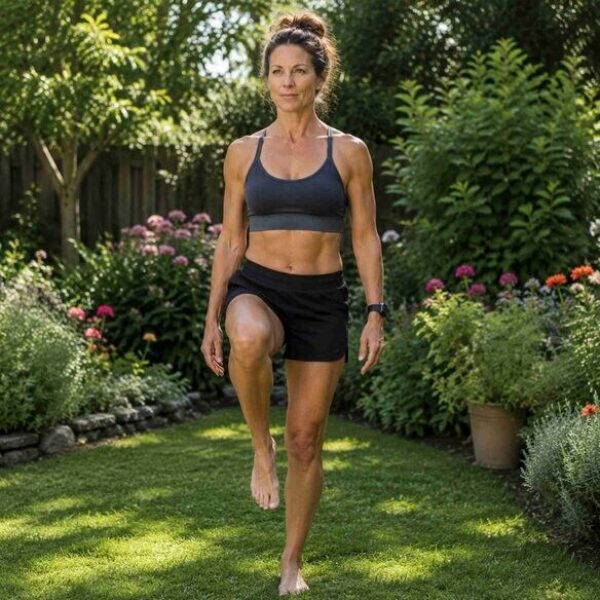
The One Legged Stance Test measured how long participants could balance on one leg. Participants in the intervention group increased their one-leg standing time by 3.6 seconds more than those in the control group. This test is an indicator of fracture risk– longer balance times are associated with a lower risk of fractures.1
The intervention group also increased their number of chair stands by 4.2 repetitions more than the control group. This test also requires participants to move from sitting to standing, but unlike the Five Times Sit-to-Stand test, which measures the speed of five repetitions, the 30-second chair stand test measures how many repetitions you can complete in 30 seconds.1
Although push-ups were not part of the formal outcome testing, participants in the intervention group increased their average push-up capacity from roughly 8 repetitions to 17.5. 1
This four-minute workout proved highly manageable for participants. On average, they completed the workout 81% of days, and only 11% of intervention group participants dropped out of the study before completion, compared to 21% of control group participants.1
The study’s authors summed up the results, stating “the 12-week FAST-2 intervention, including only 60 seconds of lower extremity exercises in older individuals with pre-existing walking difficulty, yielded improvement in functional performance.”1
Synopsis
The intervention group significantly improved their strength and physical function in all three diagnostic tests over the course of the 12-week intervention.
From Four Minutes To A Full Workout
This study does not suggest that a four-minute workout alone is sufficient to improve or maintain overall health. It doesn’t show that this mini-routine improves heart health, body composition, or other health factors the way a fuller workout might.
However, the results provide a strategy for addressing a specific problem, and we can draw additional conclusions from its findings. For older adults with reduced mobility, a traditional exercise intervention may prove too daunting or too difficult to start or maintain.
Pain, limited physical ability l, and exhaustion can make trips to the gym for full workouts nearly impossible. This study shows that a very short and simple daily at-home routine, with modifiable exercises, is both manageable and effective at building strength and improving physical function for older adults with mobility problems.
If such a brief workout can produce measurable benefits, imagine what a longer, bone-building exercise program could do for overall well-being, physical capacity, and bone health.
Discomfort and fear of injury are powerful demotivators, but when that fear wins out over regular exercise, health– and bone mass– suffers. This study’s intervention was highly effective, and the details help us understand why. The exercise program provided to participants had a few key features:
- Modification – The exercises were tailored to each participant’s ability level, preventing frustration and providing an on-ramp to growth.
- Safety – The participants knew these exercises were designed to be safe for them, mitigating concerns over injury.
- Convenience – Participants could do the routine in their own home, without fancy equipment, and on their own schedule.
- Support – The participants received reminders and had support from trainers.
- Variety – Over four minutes, the routine included four exercises, keeping the workout engaging and varied.
Generally, greater amounts of exercise produce greater benefits. Studies routinely find that the benefits of exercise scale with the time and intensity of exercise. Increasing your four-minute workout to eight minutes is likely to provide greater benefits to your body and bones. There’s no shame in starting small, and the science shows that the benefits begin as soon as you start moving, even if it’s just four minutes a day!
Synopsis
This four-minute workout can’t replace a longer exercise routine, but it can be an effective starting point for establishing a regular exercise habit. The intervention’s success may be thanks to key features: modifiable movements, assured safety, convenience, expert support, and exercise variety.
What This Means To You
Even just four minutes of targeted exercise can provide meaningful benefits. If four minutes a day can have such transformative effects, imagine the impact of fifteen minutes, or more!
The qualities that made this study’s intervention successful can be difficult to assemble on your own. That’s why the Save Institute created SaveTrainer. SaveTrainer is an exercise program that provides safe, guided, on-demand workouts designed specifically for osteoporosis and osteopenia and built around the movements that actually build bone.
With SaveTrainer, you get you get a personalized exercise plan tailored to your ability level with a personalized plan; you get the assurance that the workouts are designed to be safe for your bones and body; you get the convenience of on-demand workouts available anytime and anyplace; you get the support of expert trainers and a like-minded community; and an ever-growing library of workout classes that keep your exercise routine fresh and engaging. SaveTrainer checks all of the boxes that made the intervention in today’s study effective.
The shortest SaveTrainer workouts are only seven minutes long– the perfect starting place for your bone-building exercise journey. From there, the sky’s the limit!
Don’t Just Read About Bone-Building Exercise… Start Doing It.
Follow safe, guided workouts designed specifically for osteoporosis and osteopenia. Build strength, improve balance, and move with confidence using expert-led workout plans you can do from home.

References
1 https://journals.plos.org/plosone/article?id=10.1371/journal.pone.0336748





Dear Vivian I made a comment earlier – I didn’t mention that I found your WebSite around 20 years ago. I’d had a Bone Density Scan and was told my bones were the bones of a 90 year old – I was offered Fosamax by Infusion- I was thinking it over- took the script for Fosamax to my chemist and she told me about the pending court trials in the USA -I live in Australia-I followed your advice and changed my diet- I remember doing a daily exercise stamping through the house. I bought Dersercise from you – Thank fully I never took Fosamax due to your advice. Blessings
Hi Vivian, my knees are painful standing and sitting. My balance is reasonably good. I attended the GYM twice weekly – at present mostly 30 minutes on the bike. In 4months I’ll be 95years old- I walk unaided in the house- use a walker when I go out- I used to do a group of exercises over three-quarters of an hour twice weekly- I had Cortisone Injections in my knees a few months ago- my blood pressure went up and I became less active- I certainly feel weaker. Thanks for this study, it makes me realise I must continue to exercise daily. Blessings
Thank you for sharing your experience, and happy early 95th birthday, Kelsey!
It’s wonderful that you’re still staying active. This study is a great reminder that even brief, consistent exercise can help maintain strength, balance, and mobility. Listen to your body, progress at a pace that’s comfortable for you, and celebrate every bit of movement; it all adds up.
Wishing you continued strength and many blessings!
Do you have to lift heavy to improve osteoporosis?
Great question! No, you don’t have to lift heavy weights to improve osteoporosis. The key is to challenge your bones and muscles safely with progressive resistance and weight-bearing exercise. Even moderate resistance, when done consistently and with good form, can stimulate bone and muscle strength over time. In fact, lifting heavy weights without proper training or supervision can increase the risk of injury to the spine and other joints, so it’s important to progress gradually and use good technique.
Thanks for giving us helpful information, Vivian!
My pleasure, Kathy!
Thank you, Ita.
You’re very welcome, Ita!