


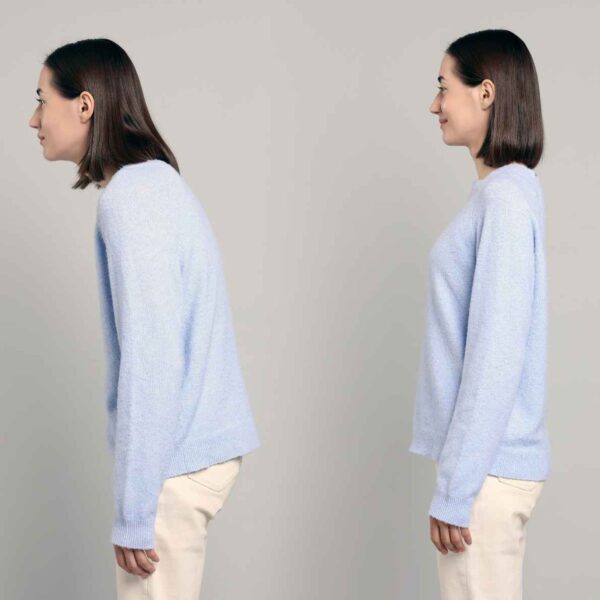
Poor posture can increase your risk of fracture, according to studies on how the alignment of the spine and pelvis impacts bone health.
The alignment of your spine and pelvis, when viewed from the side, is called sagittal balance. In this article, we’ll analyze studies on the relationship between sagittal balance and bone health, including two common postural problems: flat-back posture and pelvic tilt.
Then we’ll look at studies of exercise interventions that helped participants improve their sagittal balance, their posture, and their bone health.
Sagittal Balance And Bone Health
Sagittal balance is the ideal alignment of the spine and pelvis viewed from the side. In a state of sagittal balance, a vertical line dropped from the neck passes directly through the lower back and down into the pelvis.
Postural misalignments that disrupt sagittal balance exist in four principal types: lordotic posture, kyphotic posture, flat-back posture, and sway-back posture. Each of these misalignments disturbs the physiological loading of the musculoskeletal system– they change how the body carries weight. These changes can negatively impact physical function and the health of your vertebrae and pelvis.1
A study published in the European Spine Journal compared spinopelvic alignment among participants with and without osteoporosis. The researchers found that the two groups differed significantly in their sagittal balance. In osteoporotic patients, they noted that low femoral neck bone mineral density was associated with sagittal imbalance. 2
Synopsis
Sagittal balance describes the ideal postural alignment of the spine and pelvis when viewed from the side. Postural misalignments change how the body carries weight and can negatively impact physical function and bone health, especially in the spine and pelvis.
Flat-Back Posture
Proper spinal curvature supports sagittal balance, but when the natural curvature of the spine is increased or reduced, misalignment occurs. This misalignment puts strain on the vertebrae and causes a chain reaction of muscle response that can worsen the misalignment.
The spine has three segments: cervical (the top of the spine through the neck), thoracic (the upper back), and lumbar (the lower back). Each has an ideal degree of r forward or backward curvature. This forward or backward curvature is called kyphosis and lordosis.
Ready to Put This Into Action?
Reading about bone health is a great first step, but building stronger bones requires the right type of exercise.
SaveTrainer gives you safe, expert-led workouts designed specifically for osteoporosis and osteopenia, so you can improve strength, balance, and confidence while following a structured plan.
A forward spinal curve is called kyphosis, while a backward spinal curve is called lordosis. The cervical and lumbar spine naturally have lordotic curvature, while the thoracic spine has kyphotic curvature.
Savers might be familiar with kyphosis as a description of excessive forward curvature in the thoracic spine, causing “Dowager’s Hump”. This condition is sometimes referred to as kyphosis, although medically the excessive curvature would be termed hyperkyphosis.
Flat-back posture is a common but lesser-known spinal misalignment that frequently occurs in the lumbar spine of older adults. Flat-back posture occurs when the natural lordotic curve of the lumbar spine becomes flattened, a condition medically known as hypolordosis.
A study published in the Journal of Korean Medical Science found that flat-back posture, along with deficient anterior coverage of the acetabulum (the femoral socket in the pelvis) caused by posterior pelvic tilt, increases the risk of subchondral insufficiency fracture of the femoral head. This finding draws a direct line between flat-back posture and increased fracture risk, especially among people with osteoporosis.3
Synopsis
Flat-back posture flattens out the natural backward curve of the lumbar spine. This postural misalignment has been found to increase the risk of stress fractures in the femoral head.
Pelvic Tilt
The pelvis sits at the bottom of the lumbar spine and may tilt forward (anterior tilt) or backward (posterior tilt), impacting sagittal balance. Posterior pelvic tilt, sometimes called pelvic retroversion, is a cause of flat-back posture, and it also increases the risk of subchondral insufficiency fracture of the femoral head.3
Non-neutral pelvic tilt directly alters alignment and changes the distribution of mechanical stress throughout the spine and pelvis.. A study published in 2026 in the journal Injury measured the influence of pelvic tilt on bone mineral density across the sacrum.4
The sacrum is the large triangular bone at the back of the pelvis. It is formed by the fusion of five sacral vertebrae into a single plate of bone that serves to connect the spine to the pelvis.
The study analyzed 204 CT scans of the spine and standing radiographs of the lumbar spine. The researchers found that sagittal spinopelvic alignment was associated with differences in trabecular bone density across different regions of the sacrum.4
The study connected these variations in density to stress fractures in the sacrum among older adults. Sacral fractures are associated with severe pain, functional decline, and prolonged hospitalization. One-year mortality rates after a sacral fracture were nearly 19%, and higher among people who failed to regain independence or required institutionalization following the injury.4
These dire outcomes emphasize the importance of maintaining the health and strength of the sacral bone.
Synopsis
Non-neutral pelvic tilt causes sagittal imbalance, changing the mechanical load distribution throughout the spinal column and the pelvis. These changes in loading are associated with variations in bone density within the sacrum that may contribute to sacral stress fractures, causing pain, functional decline, loss of independence, and a mortality rate approaching 19%.
Improve Sagittal Balance With Exercise
Together, sagittal imbalance, flat-back posture, and pelvic tilt can create a destructive chain reaction within the musculoskeletal system. They misalign the body’s center of gravity, multiplying the mechanical stress and compressive forces on vulnerable, low-density vertebrae and hip bones already weakened by osteoporosis or osteopenia, increasing the risk of fracture.
A 2019 study published in the journal Advances in Orthopedics analyzed a public health initiative of the Japanese Orthopaedic Association (JOA), which identified older adults with reduced physical function and mobility as having “Locomotive Syndrome.” The JOA recommended “Locomotion Training” as an intervention. The study investigated the possible improvement of sagittal balance through this exercise intervention.5
The intervention was designed to improve and maintain motor function using two simple exercises: squats and single-leg standing. That initial program expands to include other movements like heel raises, front lunges, and walking.
Telephone interviews revealed that 12.6% of participants reported less back pain while 17.2% reported reduced knee pain. While these reports are subjective self-descriptions, they point toward the potential of simple exercise interventions to have significant benefits, especially in largely sedentary populations.5
During the single-leg standing exercise, participants stood on one leg with their eyes open next to a stable chair or desk for support if needed. They stood one minute on each leg, three times a day (morning, noon, and evening), every day.
During the squat exercise, participants slowly lowered themselves as though sitting in a chair and then returned to standing, keeping their knees aligned over their toes and limiting knee flexion to 90 degrees. They performed slow squats five to six times per set, three times a day, every day.
Another study found that middle-aged and older adults improved their sagittal balance through resistance training on outdoor fitness equipment. After an eight-week intervention consisting of two sessions per week of circuit resistance training at public outdoor fitness equipment, participants improved alignment of the thoracic and lumbar spine and pelvic tilt in the standing position.6
The authors concluded that resistance training was an effective way to reduce the negative effects of aging on sagittal balance.6
Synopsis
Studies have found that exercise interventions are effective at improving sagittal balance among older adults. One study reported positive results from “Locomotion Training” consisting of squats and one-leg stands, while another study found that twice-a-week resistance training improved sagittal balance.
What This Means To You
Sagittal balance is essential for protecting your vertebrae, your pelvis, and your bone health. Regular exercise, especially resistance training, can help improve your posture, strengthen your bones, and reduce your risk of fractures.
The Save Institute created SaveTrainer to help you achieve your exercise and bone health goals. SaveTrainer is an online workout video platform featuring expert-designed workouts led by professional trainers available on demand, at every ability level.
Because SaveTrainer is designed with a focus on bone health, your personalized workout plan can include training that improves your posture, incorporates resistance training, and excludes movements that could harm your spine.
Regular bone-building exercise can help you stand straighter, taller, and stronger for years to come.
Don’t Just Read About Bone-Building Exercise… Start Doing It.
Follow safe, guided workouts designed specifically for osteoporosis and osteopenia. Build strength, improve balance, and move with confidence using expert-led workout plans you can do from home.

References
1 https://pmc.ncbi.nlm.nih.gov/articles/PMC5836359/
2 https://pmc.ncbi.nlm.nih.gov/articles/PMC3657054/#Sec4
3 https://pmc.ncbi.nlm.nih.gov/articles/PMC4999410/#abstract1
4 https://www.sciencedirect.com/science/article/pii/S0020138326005048







I am a 79 year old active female who has Osteoporosis and 3 ten year old compression spinal fractures. Also, a Dowanger’s Hump. On occasion I overdo an activity and have to deal with severe muscle spasms for days. I would like to see more information for those with conditions like mine. There is so much preventative fracture information out there, but not much, if any, post fracture information. I don’t even know if I should be trying to lie on my back/hump to do certain exercises.
Bad posture also makes us look old. I want to prevent it as much as possible. Thank you!
So true, Claire! You’re welcome!
This is so informative! Thank you!
My pleasure, Kathy!
Thank you Vivian! I notice that it is much harder for me tokeep good posture as I get older. I will start working out more often now that I know this.
That’s great, Linda! And you’re very welcome!