


Savers are well versed in the bone-health benefits of Vitamin K, but a new discovery has linked the vitamin to cognition and memory via previously unknown biological mechanisms. This finding has significant implications for older adults, who are more likely to have low dietary Vitamin K intake and age-related cognitive impairment.
In the article, we’ll analyze the study and explain its findings about the importance of dietary Vitamin K. Then, we’ll review the importance of Vitamin K for bone health and ways to ensure you’re getting enough of this Foundation Supplement, including a list of the best food sources.
Low Vitamin K Intake Impairs Cognition
A study published in April 2025 in the Journal of Nutrition found that low intake of Vitamin K impaired cognition and neurogenesis (the formation of new neural tissue), and elevated neuroinflammation in mice.1
The study involved 60 middle-aged male and female mice divided into two groups: one fed a low Vitamin K diet and the other an adequate Vitamin K diet. After six months, researchers conducted behavioral tests on 26 of the mice, then collected and analyzed brain tissues for vitamin K content, neurogenesis, and neuroinflammation markers, including microglial activation.
The mice on the low Vitamin K diet had lower Vitamin K levels in their brain tissue. They also showed increased markers of inflammation within their microglia, specialized immune cells in the brain.1
Behavioral tests revealed impairments in learning and memory-related cognitive functions. Further analysis suggested that these impairments were linked to the reduced neurogenesis and increased inflammation in the hippocampus.1
While this study was conducted in mice, these findings provide valuable insight into how Vitamin K may function in human biology, especially given that the association between Vitamin K and cognitive function has already been observed in humans.1
Synopsis
A study published in the Journal of Nutrition found that low intake of Vitamin K impaired cognition and neurogenesis, and increased neuroinflammation in mice. The same or a similar mechanism is likely at work in the human body, explaining the observed links between Vitamin K and cognitive function in humans.
Vitamin K And Bone Health
Vitamin K plays multiple roles across the body, including in blood clotting, heart health, and the immune system. It’s also required for bone health due to its facilitation of a process called carboxylation. Carboxylation gives calcium the ability to bind to the bone matrix.
Stronger Bones. Without Drugs. Guaranteed.

The natural and evidence-based program that helps reverse osteoporosis and osteopenia in 12, 6, even 3 months… guaranteed.

Without Vitamin K, your body cannot properly use calcium to strengthen your bones. This makes Vitamin K as essential as Vitamin D, which facilitates calcium absorption, yet far less well-known as essential for building bone mass.
There are three forms of Vitamin K:
- Vitamin K1 (phylloquinone) is most closely involved in blood clotting and liver health.
- Vitamin K2 (menaquinone) is used in soft tissues, heart tissue, and bone production. This is the form of Vitamin K typically present in brain tissue that was found in reduced levels in the brains of the mice on a low Vitamin K diet.
- Vitamin K3 (menadione) is the synthetic form of Vitamin K. The Save Institute recommends avoiding K3.
Vitamin K2 directly supports bone health and indirectly promotes it by maintaining healthy brain function. Vitamin K1 also helps maintain healthy bones by supporting liver function. The liver plays a key role in protecting the bone remodeling process from toxins and preventing bone-damaging acidification.
Synopsis
Vitamin K facilitates blood clotting, heart health, and the immune system. It also allows calcium to bind to the bone matrix. Vitamins K1 and K2 both play roles that impact bone health. Vitamin K3 is synthetic and should be avoided.
How To Get Enough Vitamin K
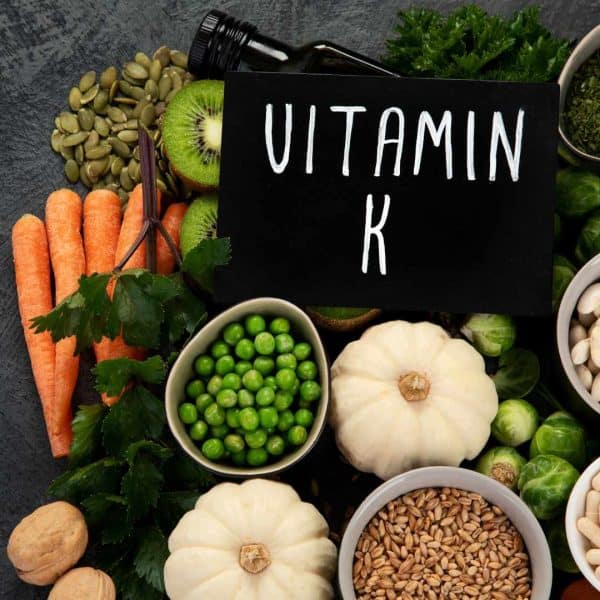
You can get Vitamin K1 through your diet from a variety of foods, listed below.
- Collard greens*
- Turnip greens
- Spinach*
- Kale*
- Broccoli*
- Cashews*
- Soybeans
- Pumpkin*
- Okra
- Pine nuts
- Blueberries*
- Pomegranate juice
- Grapes*
- Carrots*
- Olive oil
*denotes Foundation Food
Vitamin K2 is found in relatively few foods. Fortunately, Intestinal bacteria synthesize most of the Vitamin K2 our bodies need. However, it can be found in chicken and in some fermented foods, most notably a form of fermented soy called Nattō.
To ensure adequate Vitamin K2 intake, the Save Institute recommends supplementing with 180 mcg per day.
Synopsis
Ensure your diet contains the Vitamin K1-rich foods listed above. For Vitamin K2, the Save Institute recommends supplementing with 180 mcg per day.
What This Means To You
Make sure you’re getting enough Vitamin K through a combination of diet and supplementation. The negative effects of low Vitamin K intake on cognition and memory are serious on their own, and they can also hinder your ability to maintain a bone-healthy lifestyle.
The Osteoporosis Reversal Program employs a holistic approach to preventing and reversing osteoporosis. This allows the program to use every available tool to support not just stronger bones but better overall health. It encompasses not only diet and supplementation (including Foundation Supplement Vitamin K2), but also exercise, quality sleep, managing exposure to environmental toxins, and other lifestyle choices that support the healthy, independent future you want and deserve.
Stronger Bones. Without Drugs. Guaranteed.
The natural and evidence-based program that helps reverse osteoporosis and osteopenia in 12, 6, even 3 months… guaranteed.

References
1 https://www.sciencedirect.com/science/article/abs/pii/S0022316625000306?via%3Dihub







Isn’t it true that your body makes Vit K if you have enough probiotics in your gut?
Good question, Kathy! Certain strains of probiotics, such as Lactobacillus and Bifidobacterium, can produce Vitamin K2 in the gut. However, it is still recommended to obtain Vitamin K2 from diet and supplementation. And keep in mind that taking antibiotics can disrupt the balance of your gut bacteria, potentially affecting vitamin K levels, among many other things.
I found this helpful and informative. Thanks!
My pleasure, Sharon!
Huge thanks for this! My husband read about the value/role of K2 some years ago. When I was diagnosed with osteoporosis four years ago my GP recommended I take D3. I said “along with K2?”. He was completely puzzled and said “No of course not – why would you do that?”. Fortunately I ignored him and take both. Well done Save!
You’re very welcome, Lin! I’m glad you’ve been taking K2!
Appreciate the helpful content. thanks!
You’re welcome, Kathy!
K2 is ONLY from grass fed proteins like meat, cheese, especially Gouda and Jarlsberg cheeses! Yes, you could also take natto, but it wouldn’t get past my lips. Raw kefir, beef liver caps and eel are also good choices, or you could buy a K2 ONLY supplement! I say that because I only get my D from the sun and K2 separately!
Thanks for chiming in! At the Save Institute, we recommend taking a K2 supplement to ensure you’re getting enough.