


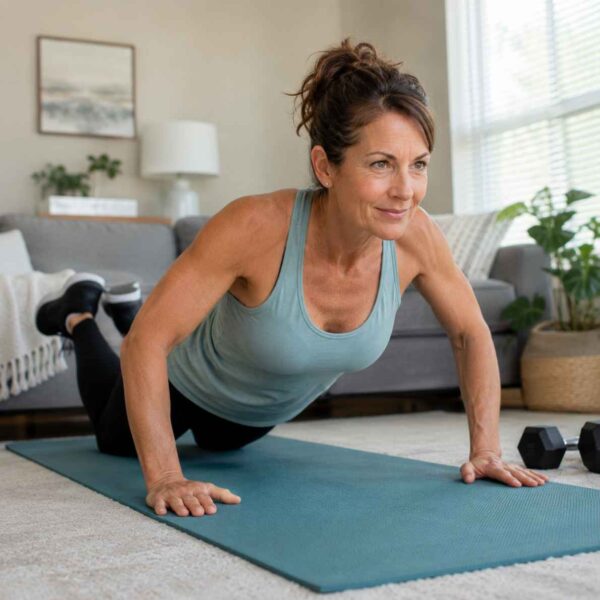
A University of Edinburgh study has linked stronger torso muscles to a 31% reduction in heart attack risk. In this article, we’ll analyze this study and its remarkable findings for cardiovascular health.
Then, you’ll learn about the under-appreciated connection between the same muscle groups and bone health. We’ll detail five ways strong chest and back muscles support bone health, helping to reduce fracture risk and enable a bone-healthy lifestyle.
Strong Torso Muscles Linked To Lower Heart Attack Risk
A study published in 2026 in the journal Radiology analyzed routine heart scans from 1,722 participants, most of whom were in their 50s and all of whom reported chest pain. Analysis of those scans found that participants with greater muscle density in their chest and back were less likely to have a heart attack or die in the decade following the scan.1
The quality of muscle could be assessed using the brightness of the scan, and researchers found that for every 10-point increase in scan brightness, participants were 31 percent less likely to have a heart attack and 39 percent less likely to die over 10 years of follow-up. These results persisted even after results were adjusted to account for other factors that might increase participants’ risk of heart attacks and death, including age, sex, and arterial calcium build-up.1
Greater muscle mass and density are typically the result of physical activity and exercise. These findings provide additional evidence that exercise has complex and far-reaching benefits, including reducing the risk of cardiovascular disease by as much as one- third.1
Synopsis
A 2026 study analyzed routine chest scans and found that participants with denser chest and back muscles were more than 30 percent less likely to have a heart attack or die in the following ten years.
Back, Chest, and Torso Muscles Also Support Bone Health
The same muscle groups this study linked to a reduced risk of heart attack also play an important role in bone health. These five benefits are supported by published studies, and each provides another reason for Savers to strengthen their core and torso muscles.
1. Increase the mechanical loading that supports bone remodeling
Muscle mass provides mechanical loading that stimulates bone growth. Bone contains mechanosensitive cells that respond to the strain of mechanical load by triggering the creation and activity of bone-building osteoblasts. Wolff’s Law first describes how bone adapts to the loads placed upon it .
Greater torso muscle mass reflects regular physical activity, which also stimulates bone growth. Greater muscle mass increases potential mechanical loading on bone, creating a virtuous cycle that supports greater strength and bone formation.2,3
Ready to Put This Into Action?
Reading about bone health is a great first step, but building stronger bones requires the right type of exercise.
SaveTrainer gives you safe, expert-led workouts designed specifically for osteoporosis and osteopenia, so you can improve strength, balance, and confidence while following a structured plan.
2. Improve spinal alignment
An article published in the British Journal of Sports Medicine established key recommendations for physical activity and exercise for people with osteoporosis. Its authors recommended:4
- Resistance and impact exercise to maximise bone strength
- Activities to improve strength and balance to reduce falls
- Spinal extension exercise to improve posture and potentially reduce risk of falls and vertebral fractures
While the first two recommendations include many muscle groups, the third specifically targets the muscles that support the spine. Spinal extension exercises strengthen the muscles around the spine, improving alignment, stabilizing the spine, and reducing vertebral pressure.
The authors also note that exercises that strengthen spinal muscles may reduce pain and kyphosis (also known as dowager’s hump), thereby reducing risk of falls and fractures.4
3. Enhance balance and lower fall risk
If you’re less likely to lose your balance, you’re less likely to fall. You might think that balance depends primarily on the feet, ankles, and leg muscles — but the torso muscles also play a critical role in maintaining balance.
A 2023 position statement in the Journal of Bone Metabolism analyzed fall-prevention exercise programs and found that programs targeting strength and balance appear particularly effective.5
Based on the studies included in their review, the authors recommend professionally supervised strength and balance training for three hours a week over at least four months. A combination of balance and other weight-bearing exercises has been shown to help prevent age-related bone loss and reduce falls in older adults with low bone mass.5
4. Make daily activities and exercises safer and easier
A systematic review published in the journal Physiotherapy Canada found that resistance exercises increased self-reported physical function and daily activities in older adults with osteoporosis or osteopenia.6
The exercise protocols participants followed focused on back and core strengthening, as well as upper and lower extremity and trunk strengthening. Three of the interventions used targeted resistance exercises two to three times per week, ranging from 50 to 60 minutes per session.6
Chest, back, and core muscles contribute to far more daily activities than you may realize. Strengthening those muscles improves your ability to live your life fully and to complete the bone-building exercises that help prevent and reverse osteoporosis.
5. Break the cycle of inactivity that accelerates both muscle and bone loss
An article on osteosarcopenia published in the Journal of Cachexia, Sarcopenia, and Muscle linked core muscles to the ability to stay active and maintain overall muscle mass.7
Osteosarcopenia is the coexistence of osteoporosis and sarcopenia, or bone loss and muscle loss. Lifestyle factors including sedentarism, obesity, and poor nutrition interact with genetic and hormonal factors to cause this condition at the intersection of sarcopenia and osteoporosis.
The study authors write that “Combined resistance and balance exercises with nutritional supplementation (whey protein, vitamin D, calcium, creatine) for those with deficiencies is a potent strategy to curb osteosarcopenia.”7
Building stronger core and torso muscles provides the strength and endurance to stay physically active. As this study notes, sedentarism and obesity are leading lifestyle factors that contribute to osteosarcopenia. Strengthening the torso muscles helps break the cycle of inactivity by improving the strength and endurance needed to stay physically active..7
Synopsis
Strengthening back, chest, and torso muscles supports bone health by increasing mechanical loading, improving spinal alignment, enhancing balance, making daily activities easier, and breaking the cycle of inactivity
What This Means To You
Strengthen the muscles of your back, chest, and abdomen to build bone, protect your spine, improve your posture and balance, and support your overall health — including lowering your risk of heart attack.
The Save Institute created SaveTrainer to provide comprehensive workout programs that engage and strengthen every muscle group– including your torso. SaveTrainer is a digital workout platform that provides on-demand classes from professional trainers, designed to improve your bone strength and health. SaveTrainer workouts are built around weight-bearing movement, resistance training, and impact-appropriate loading: the specific mechanics that signal your body to build new bone tissue. Importantly, SaveTrainer only provides workouts that are safe for your spine.
When selecting core exercises, Savers should be careful to avoid repeated bending or arching of the spine under load, bending and twisting the spine at the same time, and exercises performed with a flexed, non-neutral spine.
Unsafe movement patterns like these are intentionally excluded from SaveTrainer to protect vulnerable areas such as the spine, hips, and femur, so you never have to second-guess what’s safe for your bones.
Every move you make helps make you stronger — so keep moving and keep building your bones.
Don’t Just Read About Bone-Building Exercise… Start Doing It.
Follow safe, guided workouts designed specifically for osteoporosis and osteopenia. Build strength, improve balance, and move with confidence using expert-led workout plans you can do from home.

References
1 https://pubs.rsna.org/doi/10.1148/radiol.251821
2 https://pmc.ncbi.nlm.nih.gov/articles/PMC5601257/
3 https://pmc.ncbi.nlm.nih.gov/articles/PMC3412134/
4 https://pmc.ncbi.nlm.nih.gov/articles/PMC9304091/
5 https://pmc.ncbi.nlm.nih.gov/articles/PMC10345999/





I take better bones and balance classes but still appreciate all the nutrition and physical information you impart to help me with staying healthy and strong.
Thank you for your continuous and helpful exercises….you are truly amazing!
I appreciate your efforts to keep us informed. Thanks Vivian!
You’re very welcome, Sharon!
Thank you! As always, very eye opening!
My pleasure, Linda!
Thank you Vivian! I notice as I’m getting older more flabby around my waist. Knowing this really makes me want to improve that.
You’re welcome, Kathy! I’m glad to know that you will become proactive about that!