


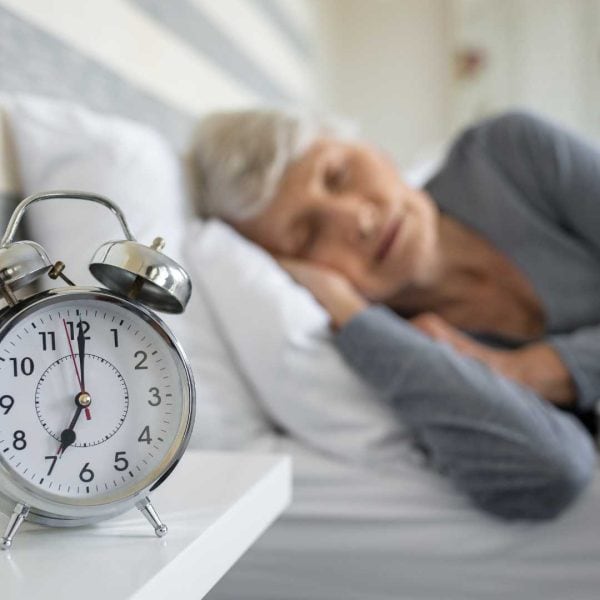
You spend about a third of your life sleeping, so it’s no surprise that your sleep position has an impact on your body and overall health. Naturally, your daily energy levels are tied to sleep quality, but your bone health also depends on getting a good night’s rest.
In this article, we’ll review the importance of sleep for bone health and examine how your sleep habits may contribute to osteoporosis. You’ll learn about the most common sleep positions, how they impact your bone health, and the best sleep positions for maintaining strong bones.
Healthy Bone Remodeling Requires Quality Sleep
Studies have linked short sleep duration and poor sleep quality with bone loss.1
The body maintains strong and healthy bones through the process of bone remodeling. Osteoclasts resorb old or damaged bone cells, while osteoblasts deposit new bone tissue, ensuring that bones retain the flexibility and strength needed to resist fractures.
Byproducts of bone remodeling are measurable in the blood and urine, allowing scientists to observe that peak levels of bone remodeling occur overnight, during sleep. This observation is reinforced by studies that have found associations with low sleep duration and bone loss.2
This relationship isn’t one-directional; sleep and bone health influence each other. The 2003 National Sleep Foundation Survey found that individuals with osteoporosis were 67% more likely to sleep for less than six hours each night. Osteoporosis and osteoporotic fractures can reduce sleep duration and quality– an effect that may spur additional bone loss and create a negative spiral.1
Synopsis
Sleep duration and quality impact bone health. Poorer sleep has been associated with osteoporosis and bone loss. However, osteoporotic fractures and other bone or joint problems can impair sleep, leading to a negative spiral of poor sleep and fractures.
Build Sleep Habits That Break Harmful Cycles
We know that poor sleep can increase your risk of bone loss, osteoporosis, and other health problems. We also know that fractures, pain, and poor bone or joint health can impair your ability to sleep. One way to break this negative cycle is by improving your sleep hygiene, including sleep position.
There are many behaviors that you can incorporate into your day and night to help you get the recommended seven to nine hours of continuous sleep. Identify one of the following habits that you don’t currently practice and try incorporating it into your routine . Be patient with yourself as you incorporate this new behavior– progress isn’t always linear. Taking two steps forward and one back still moves you toward your goal, provided you keep trying!
- Move Your Body Every Day – A regular exercise routine is essential for building bone and muscle to prevent falls and fractures. It can also improve sleep quality. If you don’t have a daily exercise routine, try adding a new physical activity on your non-workout days to ensure you’re active every day. That could be a brisk walk, a stretching session, a little bit of yardwork, or tai chi. Even fifteen minutes of additional daily activity can help prime your body for nighttime rest.
- Choose Nightly Wind-Down Behaviors – Your pre-bedtime activities can support or detract from your ability to get to sleep and stay asleep. Put away screens a couple of hours before you hit the hay. Some people dock their phones in a charger in another room so they won’t be tempted to scroll in bed. Instead, choose a set of calming and consistent rituals. Drink a calming cup of herbal tea, read a book, avoid alcohol and caffeine, and ensure your sleeping area contains the cozy items that help you feel relaxed and comfortable.
- Get Some Sun – The body has multiple mechanisms for sensing daytime versus nighttime. Not only can you see the sun, but your skin absorbs its rays to produce Vitamin D. The information your body receives about the rhythm of day and night directly informs your body’s circadian rhythm, which regulates sleep. Diurnal body processes (like bone remodeling) use this information to set their rhythms as well. Spend a little time in the sunshine, especially in the morning, to help align your internal clock with the day-night cycle.
- Pick A Supportive Mattress And Pillows – This task ties into our next subject, sleep position. The perfect mattress and pillow are highly personal, but may correlate to the position you sleep in. If you decide to transition to a new sleep position, getting a new pillow (or even a new mattress) may help you succeed. If you find your current mattress or pillow uncomfortable, stop suffering and find a better one. The stakes for getting good sleep are high, as the data on sleep and osteoporosis show. This isn’t just pampering yourself– comfortable sleeping conditions are a matter of good health.
Synopsis
Stronger Bones. Without Drugs. Guaranteed!

The natural and evidence-based program that helps reverse osteoporosis and osteopenia in 12, 6, even 3 months… guaranteed.

Break the negative cycle of poor bone health and poor sleep by improving your sleep hygiene. Try one of the four strategies listed above and give yourself time to consistently implement the change. Then add another!
Sleep Position Can Create Stress Or Support Rest
Not all sleep is restful. Almost everyone has had the experience of waking up in the morning sore or stiff, perhaps with a pain in the neck, shoulder, or joints. Too often, instead of taking the problem seriously, we explain the discomfort away by saying we “slept on it funny.”
Over time, we might think that feeling physically out of sorts is just our new normal, when in fact, changing sleep position could help us feel better. As we age, it can get harder to get enough sleep due to physical issues that make us less comfortable.
For Savers, maintaining a neutral spinal position is one of the most important characteristics of an ideal sleep position. Your spine is in a neutral position when the head is positioned with the ear over the shoulder, and the shoulder in line with the hip joint. This neutral position lengthens your spine and protects its natural alignment. That alignment should be the goal whether you’re sitting, standing, or sleeping. Keep it in mind as you consider the following options.
- Stomach Sleeping – Stomach sleeping stresses the neck and lower back. It can cause unnatural curvature of the spine, leading to discomfort and putting stress on the vertebrae. As a result, stomach sleeping is associated with increased neck strain and reduced spinal alignment. However, stomach sleeping is sometimes preferable for people with sleep apnea (a condition in which breathing pauses during sleep, interrupting and reducing sleep quality). If you can’t sleep any other way, get a thin pillow to minimize strain on your neck, but bear in mind that stomach sleeping places the neck and cervical spine under significant rotational pressure, which can cause soreness and stress on vertebrae and muscles. Consider attempting to transition to another sleep position.
- Fetal Position – The fetal position is a side sleeping pose in which the legs are bent and pulled up towards the chest. It doesn’t create a neutral position for your spine, but it can provide relief for those with herniated discs or spinal stenosis. However, it is essential to avoid curling too tightly, as this may restrict breathing and cause stiffness in the morning. For some people, a fetal position can help reduce lower back pain. You can reduce the risk of soreness by holding this position loosely. Try extending your legs a little so they aren’t bunched too tightly. Put a pillow between your knees and ankles to keep your top leg level with your pelvis. This will help to protect your joints and prevent morning soreness.
- Side Sleeping – Side sleeping is similar to the fetal position, but instead of curling the legs up toward the chest, they are extended and loosely bent. Placing a pillow between the knees and ankles helps maintain spinal alignment and avoids hip twisting. You can also try a long “body pillow” that stretches from between your ankles all the way up to your chest. Make sure your pillow is the right size and firmness so that your neck isn’t curving up or down. If you experience shoulder stiffness or tightness in your jaw, this sleep position could be the culprit. Consider transitioning to back sleeping.
- Back Sleeping – Sleeping on your back is widely considered to be the best position for spinal health. Place a pillow under your knees in this position to help your lower back stay relaxed and neutral. Ensure your pillow is the right size and firmness to support your neck and head while keeping your spine aligned. Consider whether your mattress has the appropriate firmness to keep your spine in a neutral position– too soft and your hips may sink too deeply, causing an awkward curvature, but too much firmness might cause discomfort. Trial and error is often required to find the right mattress– that’s why mattress stores have so many beds on their display floor, so you can lie down and see how they feel! Take your time, and also take advantage of return policies if a new mattress isn’t supporting you adequately.
Use this guide to explore whether training yourself to sleep in a new position may benefit you. The process of learning to sleep in a new position can take time, so be patient with yourself, but stick with it. You can make the transition incrementally, or you may need to experiment with new pillows (or even a new mattress) to achieve good sleep.
Synopsis
Sleep positions in which the body is twisted, or the spine is not aligned, can put stress on joints and vertebrae, reducing sleep quality and causing soreness. Sleeping on your side with a pillow between your knees and ankles can provide good spinal alignment. The best position for spinal health is back sleeping, with a pillow beneath the knees to remove pressure from the lower back.
What This Means To You
Every part of your day has an impact on your bone health, and that’s just as true for nighttime! Make sure your sleeping position supports a neutral spinal alignment and a good night’s rest. If not, then it’s time to make a change.
Thoughtful consideration of lifestyle choices is essential for preventing and reversing osteoporosis, yet these factors rarely, if ever, come up in the doctor’s office. That’s why the Osteoporosis Reversal Program is such a valuable resource. It dives deep into the areas of your life that can make or break your bone health, but which you may never have considered before.
From sleep hygiene and sunlight exposure to supplementation, the ORP covers it all while providing simple, actionable steps to improve your habits and build your bone strength.
Sleep well knowing you’re on your way to more resilient bones and better health!
Stronger Bones. Without Drugs. Guaranteed!
The natural and evidence-based program that helps reverse osteoporosis and osteopenia in 12, 6, even 3 months… guaranteed.








I am a back sleeper at age 93. My problem is restless leg, & walking helps. Any suggestions?
Thank you Vivien for this up to date information. You didn’t address nighttime bathroom interruptions which a lot of women experience. Would those breaks be included or excluded from the optimum 7 hour uninterrupted sleep? Thank you again.
Thank you, Vivian! Very interesting information.
You’re welcome, Kathy!
Good to sleep on the back, the trouble is only when sleeping on my stomach can I fall asleep as I can move my legs because of a restlessness that I have been having for the past 66 years…
I’m sorry you’ve been dealing with that, Luc!