


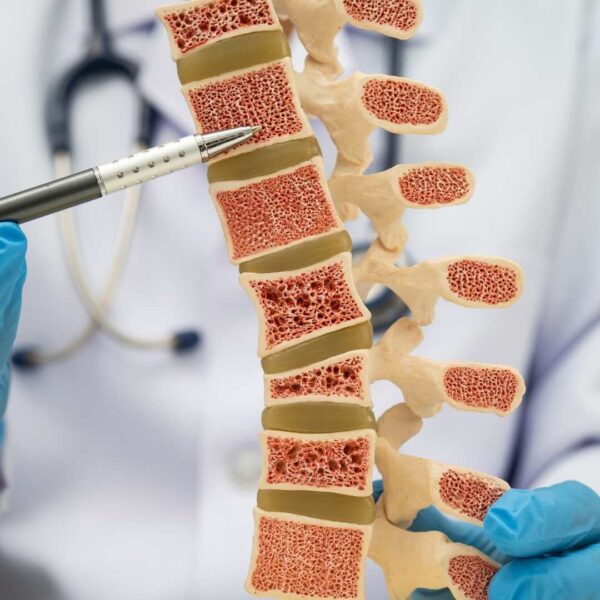
Researchers in Cleveland, Ohio, have developed a tool for measuring bone tensile strength that could improve clinicians’ ability to assess bone health and fracture risk worldwide. Tensile strength is the ability of a material to withstand the force of pulling or stretching.
For decades, the medical establishment has clung to an ineffective tool for assessing bone health: DXA scans. The bone mineral density measurement provided by this technology is a single piece of relevant information, but it is insufficient for understanding overall bone health and fracture risk.
In this article, we’ll review a newly published study on this technology, analyze its potential impact on the field of bone health, and consider how this breakthrough could help or hinder people in their efforts to stay healthy, active, and fracture-free.
A New Technology For Assessing Bone Health
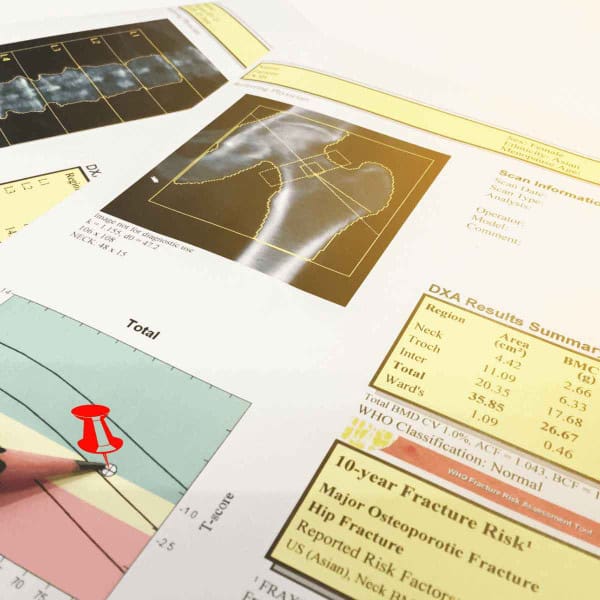
Dual-energy x-ray absorptiometry (DXA) scans are the clinical standard for assessing bone mineral density (BMD) for many years. This BMD measurement is used as the primary indicator of osteoporosis.
However, BMD measurements from DXA scans fail to identify 75% of people who suffer fall-induced fractures as osteoporotic.1 In short, DXA scans and BMD do not effectively predict fracture risk.
This finding indicates that bone mineral density is not the primary factor determining a bone’s ability to resist fracture. Researchers at Ohio University developed a new noninvasive tool, called Cortical Bone Mechanics Technology (CBMT), which assesses bone tensile strength by measuring its “flexural rigidity.”1
The developers of CBMT conducted a study to compare its efficacy to traditional DXA scans.
The study included 372 postmenopausal women between the ages of 50 and 80, nearly a third of whom had experienced a bone fracture after age 50.
The participants who experienced fractures had 22% lower bone rigidity than those without fractures. The CBMT test was significantly more effective at determining fracture risk than DXA scans.1
Strong
Stronger Bones. Without Drugs. Guaranteed.

The natural and evidence-based program that helps reverse osteoporosis and osteopenia in 12, 6, even 3 months… guaranteed.
Researchers at Ohio University developed a tool called Cortical Bone Mechanics Technology (CBMT) that assesses bone tensile strength by measuring its “flexural rigidity.” They conducted a study to compare the ability of CBMT and DXA scans to predict fractures among 372 postmenopausal women.
Bone Strength Is More Important Than Density
From the very beginning, the Save Institute has held that DXA scans do not provide an adequate or accurate assessment of bone health. The Medical Establishment’s hyperfocus on bone density coincided with the development of drugs designed to increase it.
The pharmaceutical companies that held patents on these drugs contributed to the widespread adoption of DXA scans and the Medical Establishment’s singular focus on bone density.
Meanwhile, scientists have shown that bone mineral density is not an accurate predictor of fracture risk and that bones require more than density to remain strong and resistant to fracture.
These drugs, which have generated billions in profit, focus on increasing bone density, often at the expense of significant side effects.. The ubiquity of DXA scans and the lack of a more effective qualitative measurement tool have allowed the misguided focus on BMD to persist.
A new measurement tool that evaluates a component of bone strength rather than density represents a promising development. In a press release, the study authors stated that the new technology allowed them to detect weak bones in women with a normal BMD.
Synopsis
The Medical Establishment’s hyperfocus on BMD was engineered by Big Pharma, and despite research showing that BMD is ineffective at fracture-risk prediction, DXA scans remained the only available clinical tool for measuring bone health. A new tool that measures a more predictive quality of bone could change that.
The End Of Density-Focused Osteoporosis Drugs?
This new technology will require further study before broader implementation, especially to assess its efficacy in men and in populations not represented in the initial study group.
However, the developers assert that because the Cortical Bone Mechanics Technology is noninvasive and does not require radiation, it could be used in clinical settings worldwide.
If clinical assessment of bone health shifts away from bone mineral density, what does that mean for the long list of ineffective osteoporosis drugs that doctors are quick to prescribe?
There have been no studies evaluating how these drugs affect CBMT assessment; however, because current osteoporosis drugs target density, they are unlikely to improve flexural rigidity or tensile strength.
A holistic, behavioral approach to improving bone health offers a far safer path to fracture prevention– and one that is proven to work without side effects.
Hopefully, a more accurate measurement of bone strength will lead to broader recognition that changes in physical activity, diet, and lifestyle are the most effective prescriptions for fracture prevention.
Regardless, the Save Institute will continue to provide information, community support, and practical programs to help you make changes that enhance your health and independence.
Synopsis
If BMD is finally, and appropriately, retired as the principal metric of bone health, doctors may stop prescribing BMD-boosting osteoporosis drugs. Hopefully, they will turn to holistic, drug-free prescriptions for exercise, diet, and lifestyle changes proven to reduce fracture risk without dangerous side effects.
What This Means To You
A new bone strength test may replace DXA scans and help end the misguided belief that bone mineral density is the best metric for assessing bone health and predicting fractures.
Savers are already aware of the drawbacks of DXA scans and how their results can contribute to increased osteoporosis drug prescriptions. Fortunately, the Osteoporosis Reversal Program explains the science of bone health, including an entire lesson dedicated to the importance of bone tensile strength. With knowledge and clear guidance, the ORP offers a simple path to stronger bones, better health, and an active, independent future.
Your daily choices have a meaningful impact on your health, and small, consistent changes can lead to significant results over time.. Don’t wait to start your journey to stronger bones and peace of mind.
Stronger Bones. Without Drugs. Guaranteed.
The natural and evidence-based program that helps reverse osteoporosis and osteopenia in 12, 6, even 3 months… guaranteed.

References
1 https://academic.oup.com/jbmr/advance-article/doi/10.1093/jbmr/zjag032/8487588






Thanks Vivian, I always look forward to yours email with positive news. Thankfully I’ve never taken drugs for Osteoporosis; and from my first bone density scan was told I had the bones of a 90year old. I think I was 70 then. My chemist told me when I handed her my script for Fosamax about the court cases in USA against Merck – and that she would take it herself. She saved me!! This year I’ll be 95years old. Walking unaided in my daughter’s home, where I’ve been living since I sold my home. I found your saveourbones site- changed my diet and bought Densersise. Later started at my Great Nephews GYM. Unfortunately I have Scoliosis, and although I have no pain, my back is weak and when I go out I use a walker to stand upright. Can’t remember what age I was when I fell down my laundry steps (3 steps) tiles on concrete, landed on my knees and hands, and to my amazement broke nothing. Very thankful to have found your Site Vivian. Blessings Kelsey Fickling (Australia)
Is this part of the REMS Ultra Sound bone scan process, in lieu of DXA? Or, where can we have this done?
Terry, please check out my answer to Marcia.
Where can we get one of those tests? Will Medicare cover it?
Terry and Marcia,
This can get a bit confusing right now because both technologies are still emerging. For now, CBMT is in the research stage, so it’s not available to the public yet and therefore it isn’t covered by Medicare.
REMS (the ultrasound-based scan) is available in some clinics in the U.S., but access is still limited depending on location. At this point, most insurance plans, including Medicare, do not routinely cover it, so it’s often an out-of-pocket test. The good news is that both REMS and CBMT are gaining attention, so access and coverage may improve over time.
Vivian,
Are you aware of REMS technology? A relative ely new, but FDA-approved ultrasound-based technology for assessing bone quality/strength and fracture risk?
Joanne, yes and here’s an article about it:
https://saveourbones.com/save-our-bones-bulletin-dxa-scans-may-become-obsolete-your-skeleton-might-be-older-than-you-are-the-genetic-code-of-osteocytes-revealed/
I have been trying to follow the natural way to handle my osteoporosis but my last bone scan was very discouraging.
My only alternative is taking bisphosphosonates – (risedronate)
😔
I understand how discouraging that can feel, but a single DXA result doesn’t always reflect your true bone strength.
At the Save Institute, we emphasize that bone health goes beyond density to include bone quality and lifestyle factors, which can take time to show up on a scan.
Regarding risedronate, it’s one option your doctor may suggest, but it’s important to weigh the potential benefits and risks carefully and make a decision that feels right for you.
You might also consider reviewing your current plan—nutrition, digestion, targeted exercise, and consistency—to ensure all the key pieces are in place. Many Savers find that small adjustments can make a meaningful difference over time.
Most importantly, don’t lose confidence; bone health is dynamic, and progress is still possible.
I learned about flexibilty in bones vs the DXA about 7 years ago from Cindy Obrien in Eugene, OR. Cindy taught exercise classes and educated us about the side effects of the drugs. Fosomax was the one most prescribed.
I purposely stayed away from the drugs and researched how Merck arbitrarily voted in Paris where to draw the line on a chart and then pushed the drugs. Merck designed the DXA and also the Drugs.
My journey going natural with exercise, diet ( cutting out refined sugar) included helped me to get a diagnosis of no more osteoprosis last Spring. I encourage everyone to go natural.
Marti Kersh
Thank you for sharing your inspiring journey and how your commitment to exercise, nutrition, and reducing refined sugar supported your progress!
You’re absolutely right to highlight the importance of bone flexibility and quality, not just density. That’s a key concept we emphasize at the Save Institute: strong bones are not simply dense, but also resilient and well-nourished.
Your experience is a great reminder that lifestyle plays a central role in bone health and that with the right approach, meaningful improvements are possible.
What about REMS? I would love to hear your assessment of that technology.
Mary, here’s an article about REMS:
https://saveourbones.com/save-our-bones-bulletin-dxa-scans-may-become-obsolete-your-skeleton-might-be-older-than-you-are-the-genetic-code-of-osteocytes-revealed/
Is CBMT test available and does Medicare cover it? Are there any trial studies? I tried Save Your Bones program for several years and my DEXTRA got worse so I had to try something else. I have severe stenosis and osterophorosis so I cannot have back surgery was on prolia and now Tymlos’s shots daily. I have not had a fracture even though I fell pretty bad 2 years ago. I would love to find out more abought my bone strength and would love to be in a study. My Tymlos is extremely expensive and will not know it is working until May. Cannot stay on it passed 2 years due to possible bone cancer. Any advise?
Thank you for sharing your experience—and it’s wonderful that you didn’t have a fracture after your fall, which suggests stronger bones than a DXA alone might indicate.
CBMT is still in the research phase, so it’s not yet available clinically or covered by Medicare, though there are ongoing studies you can look into on ClinicalTrials.gov. Another option is the REMS scan (Radiofrequency Echographic Multi Spectrometry), which uses ultrasound instead of radiation and can assess both bone density and aspects of bone quality. However, it’s still emerging, not widely available, and typically not covered by insurance yet.
You’re also correct that Tymlos is limited to two years. While medications can help, they don’t capture the full picture; fracture risk doesn’t always match DXA scores.
At the Save Institute, we emphasize that bone strength goes beyond density to include bone quality and lifestyle factors. Continuing with targeted nutrition, safe movement, and a broader view of your progress is a very sound approach.
Do you have any articles on REMS scans (Radiofrequency Echographic Multi Spectrometry)?
I agree with Jeff. I’ve had a REMS scan, not involving radiation and using an ultrasound technology. My scores seemed much more helpful as they measure bone quality, not just density. And the technician was so well informed. His information is very similar to yours, Vivian.
Where did you have the Rems scan? I would be willing to travel to get one and I would pay out of pocket. Any place on the East Coast?
The Echolight website has a list of locations that offer REMS. https://us.echolightmedical.com/find-a-provider/
I had a REMS scan at Integrative Medicine at Crossroads Medical Group, Ellicott City, MD. They’re listed through Crossroads Apothecary on the list.
I would love to read about that REMS, never heard of it. Thanks in advance🤓
Here’s an article about REMS:
https://saveourbones.com/save-our-bones-bulletin-dxa-scans-may-become-obsolete-your-skeleton-might-be-older-than-you-are-the-genetic-code-of-osteocytes-revealed/
This is so encouraging! It’s past time the science catches up with the holistic approach to health care. Especially, alternatives to the bone drug treatments offered for osteoporosis.
Indeed, it is!