


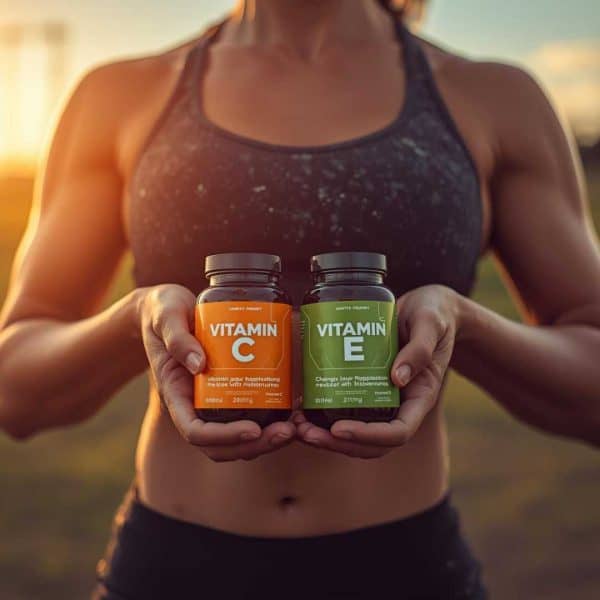
Daily Vitamin C and E supplementation increased muscle growth in older adults with chronically elevated inflammation during a 12-week resistance training program, according to a study published in August 2025. This valuable finding may provide a useful strategy for Savers to increase muscle mass, which is essential for building strong bones.
However, this result appears to conflict with previous studies that found Vitamin C and E supplementation impeded muscle growth. We will examine each study to reveal critical differences that explain the conflicting outcomes and offer a clearer understanding of whether higher-dose supplementation with these vitamins could benefit you and your bones.
Vitamin C & E Can Support Muscle Growth
A study published in the journal Medicine enrolled 60 older women with sarcopenia (aged 60-75 years old) and randomly assigned them to two groups: an antioxidant supplementation group taking 1000mg per day of Vitamin C and 335 mg per day of Vitamin E, or a placebo group. All participants completed the same 12-week elastic-band resistance training program.
The researchers measured participants’ muscle mass, muscle strength, physical performance, oxidative stress, and pro-inflammatory factors at baseline and after the 12-week intervention.
The researchers found that muscle mass, strength, and physical performance increased in both the antioxidant group and the placebo group. However, the antioxidant group had greater increases in muscle mass and strength than the placebo group.1
Testing revealed that serum levels of two pro-inflammatory factors (IL-6 and TNFA) decreased in both groups, but IL-6 levels were lower in the antioxidant group than in the placebo group. This shift in inflammatory compound levels could help explain the mechanism behind the improved muscle growth.1
The researchers summed up their findings with this conclusion:
“Vitamins C and E supplementation combined with RT (resistance training) for 12 weeks resulted in superior adaptations in muscle mass and strength compared with RT with placebo, and the underlying mechanism could be related to the alleviation of oxidative stress and inflammation.”1
Synopsis
A study with 60 older women with sarcopenia found that supplementation with Vitamins C and E, as opposed to a placebo, led to increased muscle mass and strength during a 12-week resistance training program. The likely cause is alleviation of oxidative stress and inflammation.
Stronger Bones. Without Drugs. Guaranteed.

The natural and evidence-based program that helps reverse osteoporosis and osteopenia in 12, 6, even 3 months… guaranteed.

Vitamin C & E Can Also Impede Muscle Growth
The authors of the new study acknowledged earlier research showing that Vitamins C and E can impede muscle growth and explained the reasons for this discrepancy.
A 2014 study assessed the effects of daily supplementation with a combination of Vitamins C and E on strength following a 10-week resistance training program. That study found that participants who took antioxidant supplements gained less strength than those who didn’t take the supplements. A 2015 study in elderly men found that high-dose Vitamin C and E supplementation reduced muscle growth from strength training.2,3
The researchers point to the differing baseline redox status of participants as the determining factor in whether supplementation helps or hurts muscle growth. Redox (reduction-oxidation) refers to chemical reactions involving the transfer of electrons between molecules. These reactions are fundamental to life and occur constantly throughout your body. Redox reactions are used for energy production, antioxidant defense, and cell signaling. Redox status describes the balance of oxidation and reduction reactions in an organism or cell. One measure of redox status is the ratio of reactive oxygen species (ROS) to antioxidants.1
Participants in the more recent study were older women with sarcopenia. This population is vulnerable to antioxidant inadequacy due to age-related conditions and increased oxidative burden.
The researchers wrote that this variance in the effect of supplementation underscores the importance of personalized nutrition strategies.
Synopsis
The study included information about previous studies that had reached an opposite conclusion: that antioxidant supplementation reduced muscle growth. The difference is in who participated in the studies and their baseline balance of reactive oxygen species and antioxidants.
There Are No One-Size-Fits-All Solutions
The fact that high-dose Vitamin C and E supplementation can either improve or impede muscle growth, depending on your current condition, highlights the importance of taking a holistic approach to bone health.
There is no one-size-fits-all solution to bone loss. That’s part of why osteoporosis drugs are misguided— the same drug will behave differently in different people. Savers are well-versed in both the dangers of those drugs and their inability to improve bone quality.
Vitamins C and E suppress inflammation. However, inflammation plays a role in many bodily processes, including muscle recovery– the phase during which the body builds new muscle tissue.
Too much suppression of inflammation can mute the muscle recovery process. However, too much inflammation also impedes muscle growth. The body needs to be able to use inflammation tactically, but many age-related conditions can cause chronic low-grade inflammation. This interferes with the body’s ability to use acute, short-term inflammation productively, including for muscle repair and growth.
The Save Institute recommends taking 1,000mg per day of the Foundation Supplement Vitamin C (ascorbic acid) to support bone health. Vitamin E is not a Foundation Supplement, but the Save Institute identified it as a bone-building vitamin years ago and recommends 100 mg alpha-tocopherol, along with gamma-tocopherol and tocotrienols to ensure adequate levels of Vitamin E.
Smart supplementation is essential, especially as we age, and particularly for anyone on the path to prevent or reverse osteoporosis.
Synopsis
There is no one-size-fits-all solution to bone loss, because our bodies are individual. Age-related conditions can cause chronic low-grade inflammation, making supplementation beneficial. The Save Institute recommends 100 mg alpha-tocopherol, as well as gamma-tocopherol and tocotrienols, and 1000 mg of Vitamin C (ascorbic acid).
What This Means To You
There are no one-size-fits-all solutions, but older adults who are combating bone loss often share similar needs and concerns. That makes Vitamins C and E valuable supplements for supporting muscle growth and healthy bones.
The Osteoporosis Reversal Program covers all the Foundation Supplements, providing recommendations for intake and information that allows you to consider your personal needs and health as you decide on the right actions for you.
The Osteoporosis Reversal Program takes a holistic approach that isn’t dependent on any single action or a rigid path to stronger bones. The program meets you where you are and provides multiple pathways to becoming a healthier, stronger, more independent you.
Stronger Bones. Without Drugs. Guaranteed.
The natural and evidence-based program that helps reverse osteoporosis and osteopenia in 12, 6, even 3 months… guaranteed.

References
2 https://pmc.ncbi.nlm.nih.gov/articles/PMC5023714/#:~:text=This%20is%20consistent%20with%20the,2010






Vivian, I could not find 90 mg Vitamin E but did find 100 mg Vitamin E in softgels. Is that ok? Is 180 mg Vitamin E too much? Also I found 1000 mg in Vitamin C in softgels. Does Vitamin C help prevent Purpura on my arms and heal it so it goes away when I have it already? Please advise.
I found Vivian’s site with great information which saved me from Fosamax- when my trusted GP was promising great results. This year I’ll be 95 years old – Vivian would I have found your site 25years ago?? I’m now living with my daughter- my diet has changed; I’m due to have a Bone Density Scan in a few months.,Blessings Kelsey (Australia)
Interesting! My muscles have been sore lately. It could be from my blood pressure medicine. What may help one system could be bad for another?
P. S. I do understand the process here. I have been doing the bone exercises, and taking Vitamin C. The thought of just going off the blood pressure medicine is scary to me as it can read well into the 200’s. I am trying to make my diet more alkalizing, and started taking kefir. One of my questions is: can taking Vitamin C help this symptom from this drug until I figure out what to do about my blood pressure?
Indeed, muscle soreness can be a side effect of blood pressure medications, and it’s important not to stop them without medical guidance. The study discussed here did not specifically include people taking blood pressure medications, so its findings may not directly apply to your situation. According to the study, Vitamin C supports muscle recovery and overall tissue health, but it shouldn’t be viewed as a solution for reducing or eliminating side-effects of blood pressure medication.
It sounds like you’re taking thoughtful, positive steps with exercise and diet, and those foundations really matter for better health!
Thanks for your advice. The blood pressure goes up mostly in the doctor’s office (white coat-itis). You are right, of course.
I have been studying orthomolecular medicine since at least 2002, and I truly wish I could be the next Linus Pauling with my vitamin C intake. He took 18 grams/day when well and mega dosing. Vitamin E ONLY with all four tocotrienols and tocopherols! I try to take supps without fillers and preferably not vegan or cellulose! C certainly can cure cancer and other supps. HARM hates it, which I totally LOVE!
Thanks for sharing your experience and enthusiasm for orthomolecular medicine and your good habits! This article focuses specifically on vitamin C and E’s role in muscle health for women over 60, and people may choose different supplement approaches based on their needs. Stay healthy and fit!