


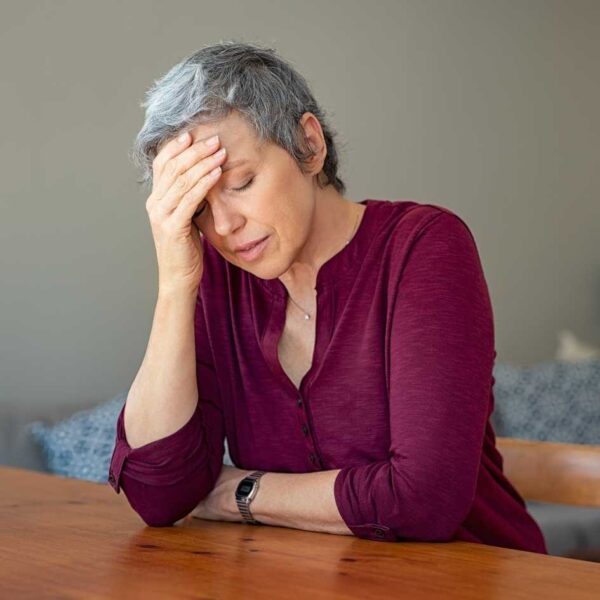
Studies have found that postmenopausal women are at heightened risk of depression. As a result, many older women are prescribed antidepressants to help alleviate the symptoms of depression.
However, a study published in 2025 has found that antidepressant use was associated with a higher incidence of osteoporosis and fractures. Since postmenopausal women are already at increased risk of bone loss due to aging and natural hormonal changes, the added risk posed by antidepressants is troubling.
We will analyze the studies that uncovered these links, as well as research identifying interventions that reduce depression symptoms without antidepressant drugs.
Depression After Menopause
A systematic review and meta-analysis published in the journal BMC Psychiatry in 2024 found that 28% of postmenopausal women experienced depression. The researchers analyzed 50 studies, including 385,092 postmenopausal women across the globe.1
The study found that women are twice as likely as men to develop depression, and the risk increases significantly after menopause.1 The risk of bone loss, osteoporosis, and fracture also increases after menopause, raising the possibility that these changes are linked and prompting research into connections between the brain and bones.
A 2026 systematic review in the journal Biomolecules examined the co-occurrence of depression and osteoporosis. The review authors focused on the brain-bone axis as a central mechanism linking the conditions. This axis is a complex network of two-way communication pathways connecting the skeletal and central nervous systems.2
The review cites evidence that depression induces skeletal deterioration through hormonal overactivity involving the hypothalamus, pituitary gland, and adrenal gland, as well as through chronic inflammation.
In the other direction, factors derived from bone actively participate in neuropsychiatric regulation. For example, one form of osteocalcin (a protein synthesized by bone-building osteoblast cells) helps enhance neurogenesis and serotonin signaling. Without healthy bone-remodelling, compounds the brain depends on for optimal function may not be available at appropriate levels.2
For postmenopausal women, a decline in bone health can trigger or worsen mental health symptoms. Conversely, depression can negatively impact the bone remodeling process. Most likely, these two conditions reinforce each other, creating a harmful feedback loop between brain health and bone health.2
Synopsis
The Only Workout Program You’ll Ever Need For Your Bones
Your bones need the right kind of movement to stay strong. SaveTrainer gives you safe, science-backed on-demand video workout classes designed specifically to improve bone health, prevent fractures, enhance posture, improve posture, and boost mobility—all from home.
A study found that postmenopausal women are at elevated risk of depression. Postmenopausal women are also at heightened risk of osteoporosis. Research on the bone-brain axis shows how these two systems depend on each other for healthy function, helping explain the co-occurrence of osteoporosis and depression.
Antidepressants Linked To Osteoporosis And Fracture
Antidepressant drugs have become a common intervention to alleviate depression symptoms. Since rates of depression are high among post-menopausal women, so are rates of antidepressant use.
However, a study published in January of 2025 in the Journal of Affective Disorders found that osteoporosis and fracture risk significantly increase with antidepressant use.3
Researchers conducted a cross-sectional analysis using data from ten cohorts of the National Health and Nutrition Examination Survey (NHANES) spanning 1999–2000 to 2017–2020. The study included 30,149 adult women and gathered data about antidepressant use, bone mineral density (BMD) scores, and reported fractures for each participant.
The study found that antidepressant use was associated with a 44% increase in the odds of osteoporosis.3
The researchers found that different classes of antidepressant drugs had different impacts on osteoporosis risk. The biggest risk increase was associated with phenylpiperazines, such as trazodone, followed by miscellaneous antidepressants and tricyclic antidepressants (TCAs such as Pamelor, Tofranil, and Silenor). Selective serotonin reuptake inhibitors (SSRIs such as Prozac, Zoloft, and Lexapro – to name a few) and serotonin-norepinephrine reuptake inhibitors (SNRIs including Cymbalta, Prystiq, and Effexor XR) also demonstrated significant, though comparatively lower associations.3
The odds of fracture was 63% higher among antidepressant users, especially those taking phenylpiperazines and miscellaneous antidepressants. 3
The researchers found that as the number and duration of antidepressants used by participants increased, so did their odds of osteoporosis.
A 44% increase in the odds of osteoporosis and a 62% increase in the odds of fracture represent substantial risk increases for adult women, many of whom may not realize that antidepressant drugs could be increasing their risk of bone loss and fracture.
The study authors underscored the need for heightened awareness of the adverse effects of antidepressants on bone health.
Synopsis
A study of 30,149 adult women found that antidepressant use was associated with a 44% increase in the odds of osteoporosis and a 62% increase in the odds of fracture.
Exercise Proven As Effective As Antidepressants
A study published in February 2026 in the British Journal of Sports Medicine found that a variety of exercise-based interventions can reduce depression and anxiety symptoms as effectively as antidepressants.4
Researchers conducted a meta-analysis of randomised controlled trials examining exercise interventions for managing depression and anxiety symptoms, including 63 studies encompassing 81 meta-analyses, 1,079 component studies, and 79,551 participants.
They found that exercise reduced depression and anxiety symptoms, with aerobic exercise demonstrating the most substantial impact on both conditions.4
For depression, the greatest reductions were seen with exercise performed in group or supervised settings, and with longer duration aerobic exercise programs lasting more than 24 weeks. Moderate intensity exercise was most effective, particularly when performed three or more times per week, although less frequent workouts still had a positive impact.4
To alleviate anxiety symptoms, workout programs of a shorter duration and lower intensity proved more effective.
Running, walking, and cycling showed the strongest ability to improve mental health, but resistance training, yoga, tai chi, and mixed programs were also effective.
Importantly, the reduction in depression symptoms experienced by participants in these studies was comparable to, and in some cases even larger than, the reduction typically reported for antidepressant drugs.4
This finding is especially important for postmenopausal women, who need effective interventions for depression that don’t increase their risk of bone loss and fracture. Not only does exercise work to relieve depression symptoms, but it also has the opposite impact on bone health as antidepressant drugs.
Exercise improves mental health and decreases the risk of fracture at the same time!
Synopsis
A 2026 study found that exercise interventions were as or more effective than antidepressant drugs at reducing the symptoms of depression and anxiety. Moderate intensity aerobic exercise programs in group or supervised settings lasting more than 24 weeks were most effective for depression, although other types, intensities, and durations of interventions also had positive impacts.
What This Means To You
Regular exercise offers postmenopausal women an extraordinary set of physical and mental health benefits. Regular aerobic workouts, especially in group settings, can reduce the symptoms of depression as effectively as antidepressant drugs in many studies. The same workout session can help to increase bone mass, build strength, and reduce the risk of falls and fractures.
Even better, as the brain and bones grow healthier, they reinforce each other through the brain-bone axis.
Bone-building exercise is so important for preventing and reversing osteoporosis that the Save Institute created an entire online workout platform to ensure Savers have a simple, effective resource for building a fun, sustainable exercise routine.
SaveTrainer offers every type of exercise program that Savers need to build bone and prevent falls and fractures, including balance classes, strength training, stretching, yoga, breathing and meditation, aerobic exercise programs, and more. You can do these programs with friends, either in person or remotely, and best of all, they’re available wherever you are, whenever you’re ready to work out.
Get your body moving today, and keep moving every day. Your mental health, bone health, and future vitality depend on it.
Most Workouts Weren’t Made for Your Bones

If you’re living with osteoporosis or osteopenia, it’s natural to worry about doing the wrong exercise. Generic programs weren’t built for you — making getting started feel overwhelming.
That’s why we created SaveTrainer…
Bone-safe on-demand video workout classes that keep you strong at every age.
Try SaveTrainer free for 14 days today and get full access to the bone-building exercise platform.

References
1 https://pmc.ncbi.nlm.nih.gov/articles/PMC11165857/
2 https://www.mdpi.com/2218-273X/16/2/213
3 https://www.sciencedirect.com/science/article/pii/S0165032724018081
4 https://bjsm.bmj.com/content/early/2026/02/02/bjsports-2025-110301





THIS!!
I was diagnosed with osteoporosis after menopause. It remained stable for several years with healthy eating and exercise…and many of your helpful tips.
Then my Dr. put me on an SSRI and I fractured 6 months later. I took myself off the med. My next DEXA showed slight improvement.
Then 2 yrs later Dr insisted I go back on the SSRI and ONCE AGAIN I fractured 6 months later!! Never again!
(I wasn’t even depressed. Just mentioned that being an empty nester was hard.)
Thanks for sharing your story and for joining the Saver community, Connie! I’m sorry that you had to go through all that because of SSRI prescriptions. Now you know better, so stick to your beliefs and stay healthy and fit!
I’m so excited about this information! My sister takes antidepressants and was diagnosed with osteoporosis. I will show her this article. HOpefully she will follow the recommendations you give. Thanks you!
I hope so too, Lenny! And you’re very welcome!
Very interesting and useful information, Vivian Thank you!
You’re very welcome, Kathy!
I paid for this a long time ago but haven’t accessed it for a long time because of my husbands health. Would you be able to check for me my old email address was gi************@****in.net.
I received the book in paper form which I loved but I cannot find it anywhere. I’m not great with the internet so I’m not sure what to do. I love your sight & think it’s extremely helpful. Thank you
Dear Sharon,
Thanks for your kind words and so sorry about your husband’s health.
Please check your email inbox within the next 24-72 hours for an answer from one of our team members.
In excellent health,
Customer Support